How Much Is FanDuel’s Super Bowl LIX Ad Like Crack Cocaine for Gamblers?

Well they Doc opened up the old mailbag today and here’s what poured out.

Dear Dr. Ads,

There I was, minding my own business and checking out MediaPost’s Marketing Daily, when I came across Danielle Oster’s piece about the new teaser ad for FanDuel’s upcoming Super Bowl commercial/canoodle with the Fox broadcast network.

Former New York Giants quarterback Eli Manning stares at a screen with the word “Destiny” under an image of a football goal post over a cosmic background in the latest teaser for FanDuel’s upcoming “Kick of Destiny 3.”

“They say destiny finds you — unless your dad and brother want you to have a quarterback destiny instead,”  Manning intones in the ad’s voiceover. Eli’s philosophical waxing about destiny is interrupted when his brother Peyton — like Eli, a two-time Super Bowl champion — shows up to ask him what he’s doing, followed by a contentious exchange.

The new teaser’s playful brotherly rivalry tone is meant to stoke excitement for FanDuel’s “Kick Of Destiny 3” Super Bowl ad, and associated programming.

Wait – and associated programming? Yes, indeed.

The Mannings will have a kickathon during the Super Bowl pre-game show, but first “FanDuel [will call] on fans to place a free bet on which brother will win the competition, with winning picks earning an equal share of $10 million in ‘Bonus Bets’ on the platform.” Then FanDuel’s two spots during the game will recap the competition.

Look, Doc, I know the corn is off the cob, and the days of Super Bowl ads that were standalones  – paid (through the nose) commercials that ran during the game and that was that – are long gone. But isn’t this a bit much?

– Bet Noir

Dear BN,

The Doc has already passed judgment on the Axis of Wheedle – the unholy trinity of sports leagues, sports broadcasts, and sports betting. Spoiler alert: It will inevitably become corrosive if not corrupt, despite being pitched as good clean fun.

Exhibit Umpteen: Fanduel’s new teaser for its Super Bowl Adstravaganza.

The Manning brothers have replaced former New England Patriots loose end Rob Gronkowski, who blew his Chip Shots o’ Destiny the last two years. But what remains is the $10 Million in Bonus Bets that who knows how many suckers will divvy up, given that they have a 50-50 chance of picking the winning Manning brother.

Great odds, yeah?

Except so-called bonus bets can quite often be the gambling equivalent of handing out free dime bags of crack on the local street corner. As Jason Quick reported in this New York Times piece, “in 2023, the [sports gambling] industry brought in a record $10.92 billion, up 44.5 percent from 2022, according to the American Gaming Association.”

Beyond that, the rate of gambling problems among sports bettors is at least twice as high as it is for other gamblers, according to the National Council on Problem Gambling, which adds that “2.5 million U.S. adults (1%) are estimated to meet the criteria for a severe gambling problem in a given year. Another 5-8 million (2-3%) would be considered to have mild or moderate gambling problems.”

To top it all off, “youth gamblers [read: males 18-30] have higher rates of gambling problems than adults.” A Fairleigh Dickinson University poll found that “one-quarter of men under 30 bet on sports online; 10 percent of young men are problem gamblers.”

Of course, sports betting companies like Fanduel always give a nod to problem gambling in their promotional materials. Here’s what appears (not actual size) at the bottom of the Manning vs. Manning teaser for all of the last eight seconds.

The Doc’s diagnosis: We’re laying plenty of eight-to-five that this problem just gets worse the more “bonus bets” get circulated. You can take that to the bank. Or not, odds are.

Why Is a Swedish VPN Service Ripping Off A Classic Volkswagen Print Ad?

Well the Doc opened up the old mailbag today and here’s what poured out.
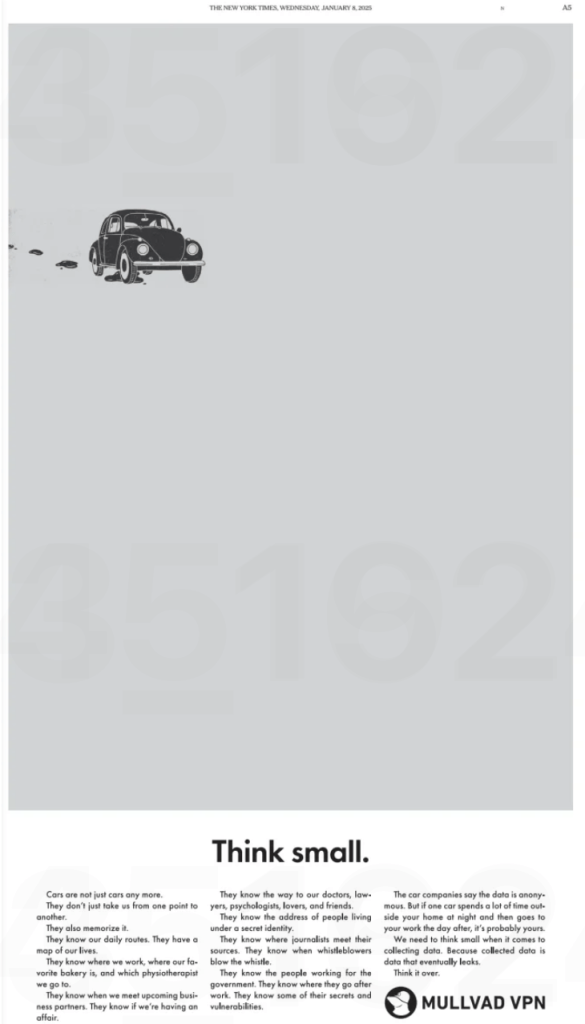
Dear Dr. Ads,

There I was, minding my own business and leafing through the New York Times, when I came across this full-page ad on A5.

That’s hardly kosher, is it Doc – outright pirating Volkswagen’s revolutionary 1959 ad? Does there remain no honor among hucksters? (Rhetorical question, of course.)

– Really Bugged

Dear RB,

The legendary ad agency Doyle Dane Bernbach really did something miraculous in the 1960s: Barely two decades after the end of World War II, it turned Adolf Hitler’s “people’s car” into an American icon.

Twice. (VW Bug, VW Bus.)

Here’s the other DDB classic ad from its launch campaign.

That car, the ad tells us, was pulled from the line because the chrome strip on the glove compartment was – gasp – blemished.

Drive U.S. automakers nuts graf:

This preoccupation with detail means the VW lasts longer and requires less maintenance, by and large, than other cars. It also means a used VW depreciates less than any other car.

The kicker: “We pluck the lemons; you get the plums.”

But back to Mullvad VPN. Here’s the company’s pitch, which is a bit of a roundhouse curve.

That “leaks” reference accounts for the black blotches beneath the Beetle in the ad. But we’re still left with this question: Why would an essentially unknown internet provider pay six figures to knock off an ad that only a fraction of its target market might recognize?

Two reasons come to mind: 1) Digital media has made popular culture – like time – a flat circle, so large swaths of people know one of The Greatest Print Campaigns of All Time, and 2) Like Volkswagen in the ’60s, Mullvad VPN is a Euro-upstart battling the behemoths – and seeming to get pretty good reviews so far, especially in the area of privacy.

The Doc’s diagnosis: At a time when your car will soon be driving you and Mark Zuckerberg is driving Meta into a ditch and Elon Musk is driving everyone else crazy, maybe a private Swedish massage would feel pretty good right about now.

Your mileage may vary.

Is the ‘Ban Pharmaceutical Advertising’ Crowd on Drugs or Something?

Well the Doc opened up the old mailbag today and here’s what poured out.

Dear Dr. Ads,

There I was, minding my own business and starting to paw through the New York Times, when I saw Rebecca Robbins’ front-page story about incoming Trump administration officials looking to euthanize pharmaceutical ads on TV.

Since the late 1990s, drug companies have spent tens of billions of dollars on television ads, drumming up demand for their products with cheerful jingles and scenes of dancing patients.

Now, some people up for top jobs in the incoming Trump administration are attacking such ads, setting up a clash with a powerful industry that has long had the courts on its side.

Robert F. Kennedy Jr., President-elect Donald J. Trump’s choice for health secretary, is a longtime critic of pharmaceutical advertising on TV, arguing that it leads broadcasters to more favorable coverage of the industry and does not improve Americans’ health. He has repeatedly and enthusiastically called for a ban on such ads.

What’s your professional opinion, Doc? Could Bobby Brainworm succeed where so many others have failed?

– On My Meds

Dear OMM,

Let’s start with a short history lesson, shall we?

Back in the ’90s, when the Food and Drug Administration first allowed pharmaceutical advertising to run on television, the ads could say the name of the drug but not what it did, or say what it did but not its name.

It was very Old Testament.

In 1997, though, the FDA bowed to the First Amendment and loosened it restrictions, “[allowing] drug manufacturers to describe the benefits of the drugs without providing long, detailed notices of the side effects. Instead, the F.D.A. said, the drug companies would be required to include in the advertisements a ‘brief summary’ of the major risks,” according to a Times piece that year.

Prescription drug commercials quickly developed a format to meet that requirement: The first half of the spot featured happy people living happy lives thanks to the wondrous effects of the drug; the second half featured a monotone voiceover intoning Contradictions & Side Effects (“Do not take Superion if you are allergic to it; side effects include headache, sudden death, something something something”) while images of windsurfers or giraffes or marching bands cranked up the Big  Pharma Distraction Machine.

(Nowadays, the Doc’s exposure to pharmaceutical commercials is largely limited to the ones that run on The Tennis Channel, most of whose viewers seem to be a) plagued by skin rashes, b) chronically short of breath, or c) allergic to whatever food their companion is enjoying.)

Those freewheeling days, however, appeared to be over when the FDA issued new rules for disclosure in the roughly $5 billion Big Pharma is slated to spend on national television advertising this year.

The Food and Drug Administration (FDA, the Agency, or we) is issuing a final rule to amend its regulations concerning direct-to-consumer (DTC) advertisements (ads) for human prescription drugs presented in television or radio format and stating the name of the drug and its conditions of use (DTC TV/radio ads). Specifically, the final rule implements a requirement of the Federal Food, Drug, and Cosmetic Act (FD&C Act), added by the Food and Drug Administration Amendments Act of 2007 (FDAAA), that in such DTC TV/radio ads, the major statement relating to side effects and contraindications must be presented in a clear, conspicuous, and neutral manner.

Drive PhRMA nuts graf: “In ads in TV format, the information presented in the audio portion of the major statement must also be presented concurrently in text for a sufficient duration to allow it to be read easily. In ads in TV format, the information in text must be formatted such that the information can be read easily. The ad must not include audio or visual elements during the presentation of the major statement that are likely to interfere with comprehension of the major statement.”

Loose translation: No more giraffes!

Except . . .

In our admittedly unscientific survey, there ‘s been only one minor change in prescription drugs ads since the FDA’s drop-dead date of November 20: the addition of small type at the bottom of the screen during disclosure. Other than that, the distraction machine grinds on.

The Doc’s diagnosis: If the federal government can’t even effectively regulate pharmaceutical advertising on television, it sure as hell doesn’t seem capable of banning it outright.

Someone send RFK Jr. some migraine medication, wouldya?

What’s So Wrong With a Matchmaker Ad Pitching You to ‘Date Like a CEO’?

Well the Doc opened up the old mailbag today and here’s what poured out.

Dear Dr. Ads,

There I was, minding my own business and leafing through the New York Times, when I came across this quarter-page ad on A7.

Really, Doc? Not to be cynical about it, but do CEOs really “date”? Doesn’t seem that way from news reports.

– Date Lyin’?

Dear DL,

Maybe this is unfair, but plug CEO sexual into Google and these are the first two Autofills.

Then again, plug CEO sexual into Google News, and here’s what comes up for just the last 10 days.

As Michael Peregrine reported in Forbes, CEO sexual harassment has become a major concern for corporate boards.

What is it about codes of conduct and sexual harassment that some CEOs apparently don’t get?

Most responsible corporate boards might be excused for thinking that they’ve already addressed the issue. Prompted by the “MeToo” movement, they’ve acted with a combination of internal education programs, new codes of conduct and strong disciplinary procedures in order to protect employees from sexual abuse and intimidation. For them, that particular “box” had been “checked off” the risk and compliance list.

Not so much, apparently. But beyond the board’s responsibility to preserve and protect the company’s reputation and workforce culture, there’s this: “[The] most current, and likely most significant, incentive is the 2023 decision of the Delaware Chancery Court concluding that sexual harassment by an officer or director constitutes a breach of the fiduciary duty of loyalty. In such a situation, the board should have a claim against that officer or director for the harm his/her action caused the company.”

Date like a CEO? That would not only be good business, but a blessing, no?

Could a Full-Page Newspaper Ad Keep the SS United States From Being Sunk?

Well the Doc opened up the old mailbag today and here’s what poured out.

Dear Dr. Ads,

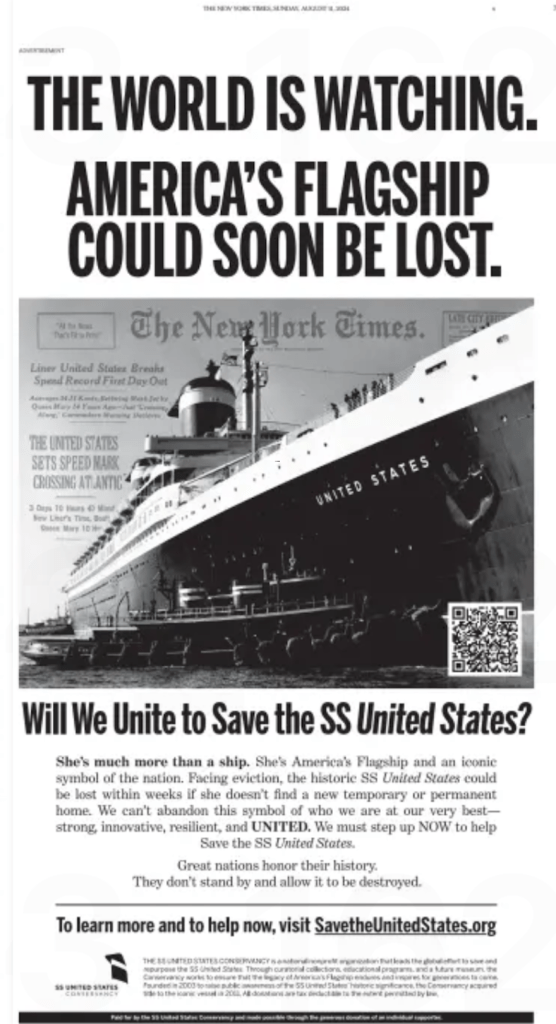
There I was, minding my own business and working my way through the Sunday New York Times (an endeavor for which there should be some kind of federal subsidy, don’t you think?), when I came across this ad on A7.

Who knew the big boat had lost its home and was in danger of being 1) chopped up and melted down, or 2) scuttled and sent to the briny deep. Think this effort to salvage the ship might float, Doc?

– Sink or Swim

Dear SoS,

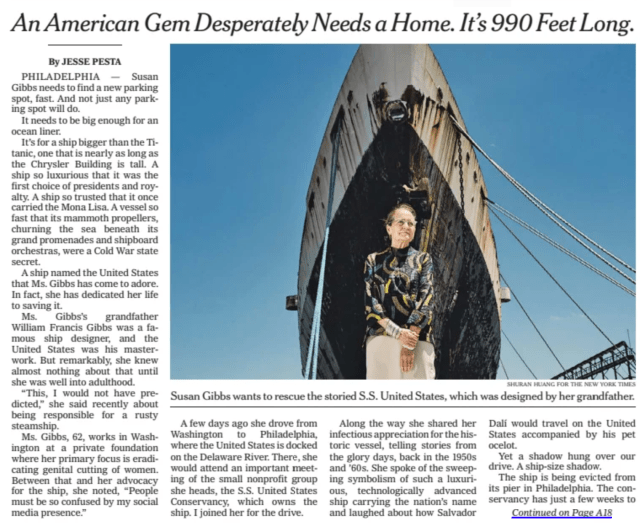
Coincidentally (or not), here’s what appeared several days later on Page One of the Times.

Jesse Pesta’s piece details the crusade to save the SS United States launched by Susan Gibbs, whose grandfather William Francis Gibbs “designed the ship, known as the Big U, which spent nearly two decades racing between its home port of New York City and European destinations [and] still holds a trans-Atlantic speed record that it set in 1952.”

(Times deputy editor Jesse Pesta “crossed the Atlantic aboard the United States as a 2-year-old and has written about the ship extensively,” for those of you keeping score at home.)

You should read the whole piece because, well, it’s a corker. (YouTube has plenty of videos, if you’re so inclined.)

But here’s the problem that the SS United States faces.

The ship is being evicted from its pier in Philadelphia. The [S.S. United States Conservancy, which owns the ship] has just a few weeks to find a new home for the United States . . .

It turns out that one of the things that makes the ship worth saving, its immensity, is what makes it so tough to save. Not only are huge piers in short supply, but there’s not even a master list of where they might be located.

The conservancy’s website explains the legal state of play for the ship: “After a lengthy legal dispute, the US District Court in Philadelphia ruled on June 14, that the SS United States must vacate the berth at Pier 82 she has occupied for decades by September 12, 2024. In her ruling, Senior Judge Anita Brody determined that the ship’s landlord, Penn Warehousing, could not double dockage fees without notice to force the ship from her pier. But the court order established a 90-day deadline to move the nearly 1000-foot-long ship to a new home.”

Axios Philadelphia’s Isaac Avilucea reports that the courts might still buy the ship some time.

A federal judge could decide Monday whether the historic SS United States can stay in its South Philly dock for a few more months while its owners negotiate a deal to sell it.

Why it matters: The ship’s stewards, SS United States Conservancy, face a looming Sept. 12 deadline to find a new home for the 1,000-foot ocean liner — and it appears multiple parties are interested, including two who want to move the ship to Florida’s coast.

Driving the news: The Conservancy wants to push the September deadline back to Dec. 5.

Unfortunately, even that could turn out to be a pyrrhic victory. Each of the Florida counties “wants to sink the boat and use it as an artificial reef and diving destination.”

The Doc’s diagnosis: This story needs a Big U-turn if the SS United States is to finally find safe harbor.

Is My TV Really Smart Enough to Track – And Sell – All My Ad-Watching Data?

Well the Doc opened up the old mailbag today and here’s what poured out.

Dear Dr. Ads,

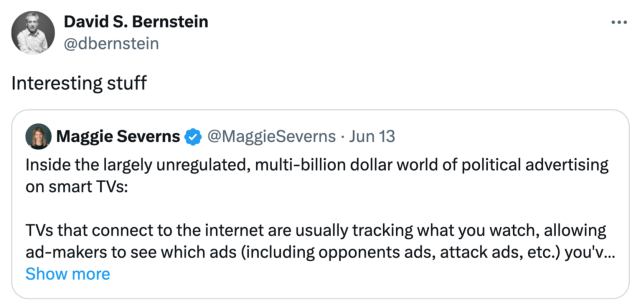
There I was, minding my own business and tooling around Xitter, when I came across this post from the always lively and informative David S. Bernstein.

Here’s the rest of Maggie Severns’ post: “. . . you’ve been hit with and how often. Sometimes they can connect TV data to a voter file, or tie your TV to your IP address, allowing ads to follow voters from one screen to another.”

That’s some serious surveillance, yeah Doc? Is that even legal? It sure doesn’t feel kosher.

– Oh Well

Dear OW,

It’s actually worse than you think, as NOTUS reporter Maggie Severns notes.

“Television now watches us more than we watch it,” said Jeff Chester, executive director of the nonprofit Center for Digital Democracy. “The same kinds of strategies used to track and target individuals in order to sell advertising popularized by Google and Meta have been purposely and deliberately exported to the television.”

Televisions that can stream platforms like Hulu or Max usually come loaded with technology that collects information on what viewers are watching, and buyers consent to have their viewing tracked when they open their new TV and click through terms of service agreements. Sometimes, data firms can connect those viewing habits to a voter’s phone or laptop via their IP address, promising a trove of information about an individual and the ability to track them across screens.

In other words, political campaigns can attach themselves to your digital data like Tim Scott to Donald Trump’s tush.

Of course, the question then arises: Does political advertising even work in this day and age? (The Doc diagnosed the current condition of presidential primary ads here.)

On the one hand, according to this piece by New York Times reporter Nick Corasaniti, traditional campaign ads are far less efficient than they used to be.

According to Cross Screen Media, an ad analytics firm, only 63 percent of Iowa Republicans [were] reachable with traditional or “linear” TV ads [this year], as viewers switch to streaming and social media. In 2016, that percentage was still in the 90s. At most, Republican campaigns this year reached 42 percent of likely caucus voters.

On the other hand, as Politico’s Jessica Piper reported, a study by Swayable, a platform used by Democrats to test the effectiveness of different messages and advertisements, was more encouraging: “[The] study’s authors . . . note that the greatest benefits would likely accrue to the best-funded campaigns and groups that can afford to create (and test) many ads in real time, not cash-strapped efforts further down the ballot.”

Either way, traditional television spots are definitely the wave of the past. Which makes the smart TVampires even more attractive to political campaigns, as NOTUS’s Maggie Severns wrote.

Today, more than half of ads booked on traditional television go to target only 11% of swing voters, according to data collected by Cross Screen Media, an analytics firm started by GOP operative Michael Beach.

Cross Screen Media estimates that close to 40% of video advertising budgets — around $4.2 billion — will go to digital ads this cycle, up from about 27% four years ago.

The Doc’s diagnosis: When your TV is smarter than you are, go listen to the radio.

Could This Half-Page New York Times Ad Be Any More Illegible?

Well the Doc opened up the old mailbag today and here’s what poured out.

Dear Dr. Ads,

There I was, minding my own business and plowing through the Sunday New York Times, when I came across this on page 7.

Honest to God, Doc – I had to take out a magnifying glass to read the body copy, and even then it was blurry. Who in her right mind (lookin’ at you, Nita Mukesh Ambani) would sign off on a mess like that?

– Read ‘n’ Weep

Dear RW,

First off, just to be, um, clear: The ad that appears in the Replica Edition of the Times is marginally sharper than the print version.

Even so, it’s still ridiculously hard to read. That’s because it violates every tenet of legendary adman David Ogilvy’s rules for effective ad copy.

Use eye-easy typography. Text set in all-caps is extremely difficult to read… sans-serif fonts are particularly difficult to read…reverse type is almost impossible to read.

Reverse type on a rose background is even more impossible to read.

The Doc’s diagnosis: The Nita Mukesh Ambani Cultural Centre in Mumbai seems like a happening place. It just needs a new art director.

Why Does a Snoopy Watch Get a Full-Page Teaser Ad in the New York Times?

Well the Doc opened up the old mailbag today and here’s what poured out.

Dear Dr. Ads,

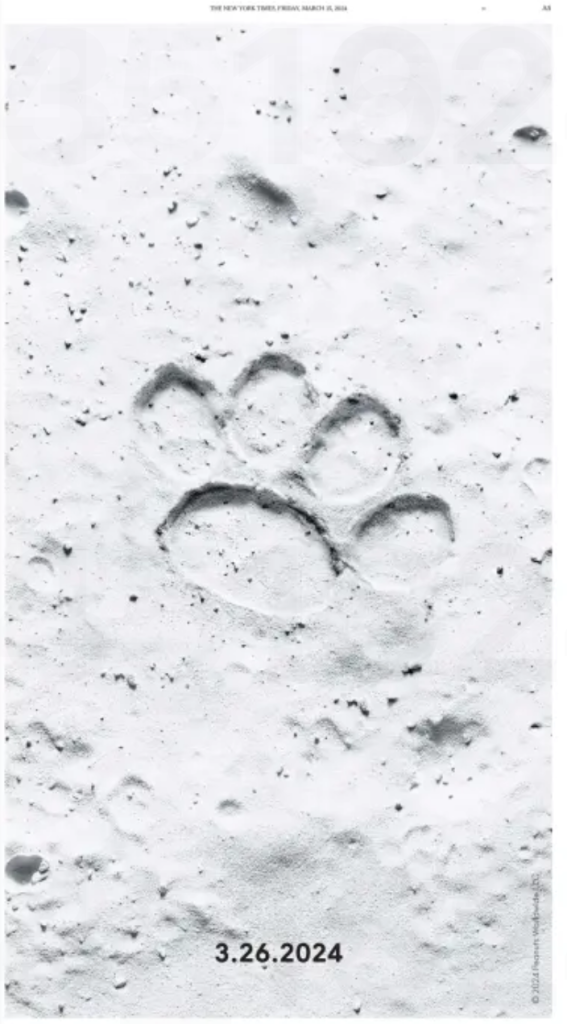
There I was, minding my own business and leafing through the New York Times, when I came across this full-page ad on A5.

What’s going on here, Doc? Is there a moon landing scheduled for later this month? Is Elon Musk planning to SpaceX his Shiba Inu Floki up there? What am I missing?

– Moon Stuck

Dear MS,

What you missed was the small © 2024 Peanuts Worldwide LLC in the lower right-hand corner of the ad. Plug that into the Googletron and you get this piece from MGB Watches, which notes that the ad also ran in The Guardian newspaper.

SNOOPY MOONSWATCH RELEASE DATE CONFIRMED – 26.03.24

The much awaited buzz surrounding the Snoopy MoonSwatch has reached its peak, as another official teaser graces The Guardian newspaper today. Capturing attention with an intriguing image of a paw print imprinted on the Moon’s surface, it unmistakably announces the release date of a Snoopy MoonSwatch: 26.03.24! . . .

26th March is such a significant date for the MoonSwatch as it marks the two year anniversary: On March 26th, 2022, Swatch unveiled the incredibly successful collection, consisting of the much loved 11x planet themed Omega x Swatch Speedmaster Watches.

For those of you keeping score at home, not everyone loved the Omega x Swatch collection, as this letter to the Doc two years ago detailed.

Dear Dr. Ads,

There I was, minding my own business and reading Jonathan V. Last’s Triad newsletter at The Bulwark, when I came across this item.

3. Watch Talk

It’s been a while since and I know that this if [sic] frivolous, but this just happened:

I have no words.

Taking the iconic Speedmaster Professional—the watch that went to the frickin’ moon—and turning it into a candy-colored hunk of plastic quartz . . . this is an abomination. An offense against God and nature. It’s like the Louvre partnering with Oscar Mayer to sell a Bologna Lisa.

So here’s my question, Doc: Do you want to see the Bologna Lisa as badly as I do?

– Swatched at Birth

Fun fact to know and tell, via Bianca Bosker’s “Lost Basquiats” piece in The Atlantic: “Researchers at the City University of New York instructed study participants to imagine that the Mona Lisa had been destroyed in a fire and asked them whether they’d rather see its ashes or a copy that not even connoisseurs could distinguish from the original. Eighty percent picked the ashes.”

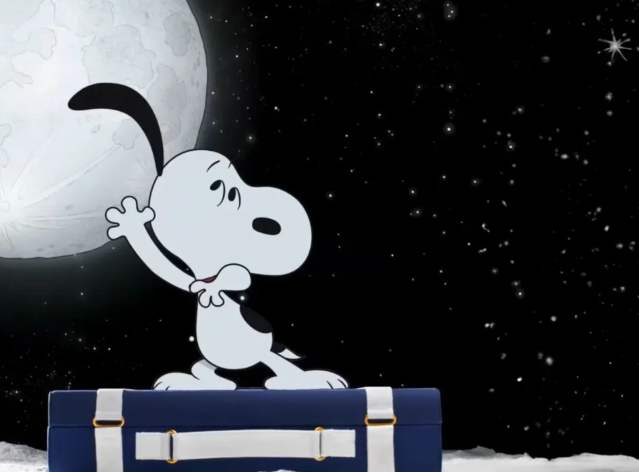
But back to MoonSwatches. Those Snoopy newspaper ads weren’t even the first teasers for the new timepiece, as Wired’s Jeremy White reported several months ago.

Considering the long-established connection between Snoopy and Omega, after the original MoonSwatch caused pandemonium around the globe in 2022 and reinvigorated Swatch’s previously flagging fortunes, it’s hardly surprising that the brand should mine this rich Schulz seam to tease a coming Snoopy MoonSwatch.

There’s only one thing that could stop this cartoon-collaboration MoonSwatch from being the most popular version of the series since the Omega X Swatch’s frenzied launch: if it’s as unimaginative and understated as the Moonshine Gold editions that followed the bright and bold original MoonSwatches.

The Doc’s diagnosis: There’s no guarantee watch nerds will be over the moon for the new Snoopy-on-a-strap when it finally lands, either.

Should Joe Biden Drop $30 Million on Ads Now or Just Set That Money on Fire?

Well the Doc opened up the old mailbag today and here’s what poured out.

Dear Dr. Ads,

There I was, minding my own business and enjoying Bess Levin’s Vanity Fair newsletter, when I came across a link to this Politico piece by Elena Schneider about a new ad blitz for Joe Biden’s re-election campaign.

[The Biden campaign] will start a six-week, $30 million TV and digital ad buy on Saturday, aimed at drawing out the “full-throated” contrast between Biden’s vision for “where the country can go” against “Donald Trump’s dark, dangerous and chaotic vision for the country,” said campaign communications director Michael Tyler on a call with reporters Friday morning. The ads will target battleground states, as well as Black and Latino-focused outlets and channels.

I dunno, Doc – isn’t that like Macy’s running ads in March for a one-day sale in November?

– Ad Homonym

Dear AH,

The Doc has taken a dim view of presidential campaign advertising on multiple occasions, but this seems to be a special case for one particular reason.

Those numbers come from an AP-NORC poll conducted last month. But Biden’s problem goes beyond the mind-boggling fact that more Americans believe Donald Trump “has the mental capability to serve effectively as president” than he does. There’s also this from a new Wall Street Journal poll, as Aaron Zitner reports.

Some 73% say Biden is too old, at age 81, to stand for re-election, the same share as in an August Journal poll. By comparison, 52% see Trump, age 77, as too old to run for the White House, up 5 points from August.

Ouch.

Baked-in public opinion like that can’t be turned around overnight, so it makes sense for Biden to get crackin’ now. And his first TV spot goes right to the heart of the matter.

The ad hits many of  Biden’s high points: Covid response, infrastructure investment, climate change reform, job growth. It also hits several of Trump’s low points, including that “he took away women’s right to choose.”

The spot ends with an outtake, as Nicholas Nehamas notes in the New York Times.

After the standard announcement that Mr. Biden has approved the message, a voice off-camera asks him to do one more take.

“Look, I’m very young, energetic and handsome. What the hell am I doing this for?” Mr. Biden replies, flashing a mischievous grin before the screen goes black.

The Doc’s diagnosis: If Biden has any chance of defusing the time bomb underneath the Resolute Desk, this approach is probably his best bet for doing so. Given that pro-Biden forces will spend close to $1 billion on advertising in the next eight months, the current $30 million ad buy is a decent way to prime the pump.

Did Adam Schiff’s Ad Strategy Really ‘Rig’ The California Senate Primary?

Well the Doc opened up the old mailbag today and here’s what poured out.

Dear Dr. Ads,

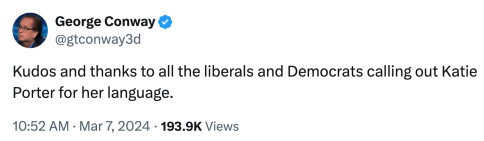
There I was, minding my own business and poking around Xitter, when I came across this tweet in “semi-recovered lawyer” George Conway’s feed.

@Out5p0ken elaborated in a reply:”Seriously, wtf and let’s all thank her for giving away a House seat and then calling the election rigged and not congratulating Schiff. Deplorable.”

What’s the deal here, Doc. Just sour grapes? Or something more rigorous?

– Katie Didn’t

Dear KD,

Katie Porter is upset because, as Joe Perticone reported in The Bulwark, “[Adam] Schiff’s campaign and his allies have shelled out millions of dollars to boost [Republican candidate Steve] Garvey’s bid and box out the other Democrats” in California’s jungle primary for the seat vacated by the late Sen. Dianne Feinstein.

Here’s a representative sample of the knee-buckling $11 million worth of ads the Schiff forces ran teeing up the former pro baseball player for GOP voters.

Post-primary, Porter cried foul, as The Daily Beast’s Matt Lewis noted.

In a tweet that has evoked controversy, Porter complained that her campaign had to withstand “3 to 1 in TV spending and an onslaught of billionaires spending millions to rig this election.”

And in a weak-sauce follow-up statement meant to clarify her tweet, Porter explained that “rigged” means “manipulated by dishonest means”—and that billionaires spending money to defeat her constitutes “dishonest means to manipulate an outcome.”

Some of Porter’s supporters protested Schiff’s strategy as “sexist and cynical” in pushing her aside for another male candidate. But that wasn’t the only factor in holding Porter to a disappointing 14% of the primary vote. As Jill Cowan reported in the New York Times, “[i]n the final weeks of the campaign, a cryptocurrency super PAC spent millions on ads attacking Ms. Porter, who has supported more regulations on the industry and has rebuked various corporate leaders in congressional hearings.”

Beyond that, there’s this inconvenient fact, which Maeve Reston pointed out in the Washington Post: “[T]o hold down Garvey’s support, Porter . . . countered with similar tactics — running at least a half-million dollars in ads raising the profile of another long-shot GOP Senate contender, Eric Early.”

Sauce for the gander, anyone?