Is the Meta/Coinbase Anti-Scam Campaign Itself Just a Brandwashing Scam?

Well the Doc opened up the old mailbag today and here’s what poured out.

Dear Dr. Ads,

There I was, minding my own business and poking around MediaPost’s Marketing Daily, when I came across Danielle Oster’s piece about a new anti-scam campaign sponsored by a bunch of scam-prone companies.

Tech Against Scams Coalition Serves Up ‘Scamberry Pie’

A group called Tech Against Scams Coalition (TASC) has launched a holiday scam prevention campaign as several companies involved in the group face lingering accusations of inadequate internal fraud prevention.

Launched in 2024, the cross-industry group includes representatives from companies including Cash App, Coinbase, Match Group, Meta, and Ripple. TASC partnered with Stereo Creative and media agency Noble People on the campaign, which the groups say was designed to inspire conversations around online fraud prevention.

According to Oster’s report, the campaign consists of “a social media ad . . . influencer partnerships, a food truck activation in Los Angeles . . . a Primrose Hill Bakery activation in London . . . and partnerships with community-based organizations such as AARP.”

So what are we talking here, Doc – mid-to-high five figures, plus creative fees? Isn’t this whole thing just a bargain-basement play for news coverage?

– Sam the Scam

Dear StS,

From all appearances, you’re right on the money.

Here’s the social media ad . . .

Not to get technical about it, but the video’s “Scam Fast Facts” are on-screen for all of three seconds, and the Scamberry web address appears in the tag for maybe two.

Feels kind of, well . . . scammy?

What’s most likely to happen is that the giveaways will get two minutes one night on local newscasts and the campaign will be over before you can finish your scamberry pie.

Meanwhile, here are some recent headlines you might find relevant.

Meta reportedly projected 10% of 2024 sales came from scam, fraud ads

Lawmakers pressure dating sites as $1.3 billion lost to romance scams each year

Coinbase phishing scams steal $65M in two months . . .

The Doc’s diagnosis: This Scamberry campaign is hardly gonna bury many scams.
Does New York’s SoHo ‘Fertility Concierge’ Really Need a 42-Foot Billboard?

Well the Doc opened up the old mailbag today and here’s what poured out.

Dear Dr. Ads,

There I was, minding my own business and poking around MediaPost’s Marketing Daily, when I came across Les Luchter’s piece about a billboard currently looming over New York’s SoHo neighborhood.

Let’s talk about the high price of eggs these days!

No, not the eggs now selling for more than $9 a dozen in New York City.

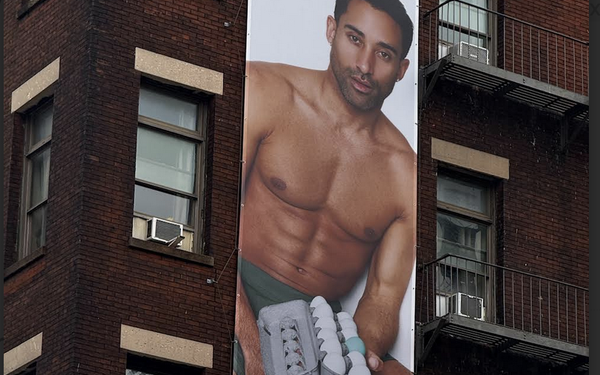
Rather, the “fertilized, not scrambled” kind, as touted on an attention-grabbing billboard which went up mid-February in New York City’s Soho neighborhood.

A 42-foot-tall photo of Stefen D’Angelica, best known for his stint on Discovery Channel’s “Naked and Afraid of Love” dating show spinoff, graces the billboard. D’Angelica, clad only in boxer shorts, holds an egg carton over his crotch. Under that, the board reads, “Fertilized, not scrambled.  @getlushi.”

Don’t even know where to start here, Doc. Maybe with the egg carton/crotch thing?

– Egged On

Dear EO,

Yes well let’s start at the beginning.

Lushi, for those of you keeping score at home, is a “fertility concierge platform” for egg freezing and IVF. About its name: “The Lushi is a rare breed of chicken known for laying blue eggs, with only a limited supply produced in its lifetime.”

That mirrors, according to Lushi’s website, “an important truth about women: they are born with all the eggs they will ever have, a finite resource that is both precious and powerful.”

Okay then.

Luchter’s piece also notes this: “D’Angelica is ‘pretty well known in the city as a very eligible bachelor,’ [Lushi founder-CEO Jessica] Schaefer points out, and the billboard has resulted in significant boosts to both Lushi’s website and social media, with ‘very high’ engagement.”

Checking in with the 42-Foot Himbo, a Google search for Stefen D’Angelica Lushi yields two links – one the MediaPost piece, the other an Ads of the World review.

Moving on to your local fertility concierge (available in New York, Los Angeles, Chicago, Boston and Austin), here’s the @getlushi Xitter feed.

(To be fair graf goes here)

To be fair, Lushi’s Tik-Tok feed has five followers.

The Doc’s diagnosis: Seems Lushi’s marketing could use a bit more fruitfulness of its own.

Why Is a Veteran Pharma Ad Copywriter Campaigning Against Pharma Ads?

Well the Doc opened up the old mailbag today and here’s what poured out.

Dear Dr. Ads,

There I was, minding my own business and checking out MediaPost’s Pharma & Health Insider, when I came across Les Luchter’s piece about the latest alarms over the “harmful outcomes” that prescription drug advertising has on consumers.

Since 2014, nonprofit RxBalance has been battling what it calls the “undue influence” of pharma marketing by running its own campaigns with such partners as Georgetown University for “Are You Prescribing Under the Influence? “[of pharma], targeted largely at healthcare providers.

Now, RxBalance has begun focusing more on telling the general public how pharma marketing can be less than transparent.  It recently launched an effort against costly Medicare drugs, focusing in particular on evidence that Eliquis from Bristol Myers Squibb/Pfizer’s Eliquis is no more effective than generic Warfarin in preventing strokes caused by atrial fibrillation — despite ad boastsof being “a better treatment.”

I dunno, Doc – is this just another do-gooder whistling past the – ahem – graveyard? Maybe RxBalance should team up with Robert F. Kennedy Jr., assuming Bobby Brainworm actually gets to run the Department of Health and Human Services.

– Drug Story

Dear DS,

For starters, the Doc already dealt with RFK 2.0 and his pipe dream of banning pharmaceutical advertising on TV.  So that’s a dead letter. (Maybe he can lay it out in Central Park in the dead of night, yeah?)

It’s hard to imagine that a bunch of civilians will have any better luck, but RxBalance founder Lydia Green told P&H Insider that she sees signs the landscape might be shifting for Big Pharma.

A lot of what we’ve been doing over the last 10 years is trying to convince people of things they find hard to believe [such as] that a doctor would make a decision…based on something that a sales rep told them. Now it’s much easier. So many of the concepts embedded in care right now were not established 10 years ago. And the pandemic created a sense of distrust in authority. People are much more open to our message.

People, sure. Federal regulators? Maybe not so much.

Even so, Green dreams on: “I personally would be happy to see no pharma advertising, and no brand awareness advertising.” Ditto for the folks at Jacobin, “a leading voice of the American left, offering socialist perspectives on politics, economics, and culture.”

In a piece headlined Drug Ads Misinform Patients and Raise Health Care Costs, Helen Santoro reported that according to one study, “drugmakers spent almost $16 billion over [a] six-year period to advertise products that didn’t provide at least moderate health benefits compared with existing therapeutic options.”

What the ads did provide, however, was a fantastic bang for the buck, as Santoro notes. “[A] report by Intron found that the return on investment from direct-to-consumer drug ads is incredibly high, ranging from 100 to 500 percent.”

So there’s that . . .

The Doc’s prescription: Keep hitting on that hopium, all you reformers. But don’t operate any heavy machinery while doing it.

Do We Really Need PRE-Teasers for the Next Round of Super Bowl Ads?

Well the Doc opened up the old mailbag today and here’s what poured out.
Dear Dr. Ads,

There I was, minding my own business and clicking through MediaPost, when I came across Steve McClellan’s Marketing Daily piece about a new ad for – not Pringles, not Pringles’ Super Bowl ad, but Pringles’ teaser campaign for its Super Bowl ad.

Pringles announced earlier this month that it was advertising in the upcoming Super Bowl, which will mark its eighth straight appearance.

And now the Kellanova brand is beginning its teaser campaign – giving hints and snippets about the ad’s storyline.

It released a “pre-teaser” on social media this week with a close-up of two uniformed actors (maybe you’ll recognize them) in a patrol car. Through the car’s radio you can hear a dispatcher telling the two officers of “reports of objects flying overhead.”

What the hell, Doc. Is there no limit to the Big Game adstravaganza?

– Stupor Bowl

Dear SB,

You are correct. We have officially entered the age of Super Bowl Ad Nauseam.

Fox Sports, which will broadcast Super Bowl LIX, has been running a teaser campaign since May, as John Sigler reported on Saints Wire.

FOX Sports released a teaser trailer for Super Bowl LIX starring their mascot “Cleatus the Robot,” who found himself wandering the desert after Super Bowl LVIII in Las Vegas. The hitchhiking robot was picked up by revelers in a party bus, complete with a brass band, Mardi Gras beads, and a pet snake, before they hit the road for “New Orleans or Bust!”

Cleatus got himself a tattoo along the way and several weeks ago was wandering around the bayou asking for directions to the New Orleans Superdome.

Oh, yeah – Cleatus has also been seen clomping through the New Orleans Saints team store, for those of you keeping score at home.

Circle of (marketing) life, yeah?

The Doc’s diagnosis: Get ready for a lot more of this teaserpalooza. There’s no bottom to that well.

Have People Really Said ‘Humbug!’ to Coca-Cola’s A.I.-Created Holiday Ad?

Well the Doc opened up the old mailbag today and here’s what poured out.
Dear Dr. Ads,

There I was, minding my own business and poking around MediaPost, when I came across Danielle Oster’s piece about a new Coca-Cola spot that has lots of people harrumphing.

Earlier this week, Coca-Cola kicked off its annual holiday advertising blitz — which has since generated buzz over the brand’s use of AI.

At the center of the campaign is a 30-second hero TV spot called “The Holiday Magic is Coming,” recreating a classic spot from 1995 while incorporating the use of AI technology in the making of the ad. Small text appears for a few seconds near the beginning, informing audiences that it was “Created with Real Magic AI” — but that announcement is s easy to miss.

For some viewers, the approach didn’t go down easy, with USA Today reporting the comments on the brand’s YouTube post of the video were largely negative.

What the heck, Doc. Does A.I. actually stand for Absolutely Idiotic?

– Xmas Xcess

Dear XX,

First things first: Here’s the Coke spot those people are snorting at.

As for that “small text” disclosure, here’s how it looks on-screen.

One YouTube commenter wrote, “Nothing like celebrating the spirit of Christmas with the most soulless commercial possible.” The MediaPost piece says, “Coca-Cola has since restricted the page, hiding comments,” but you can see 2283 comments here, so go figure.

Beyond snarky Santa claws, the inevitable culture wars have also flared up, as Salon’s Ashlie D. Stevens has detailed.

Many creators and customers were quick to criticize the campaign as being emblematic of a worrying trend of replacing human artistry with machine-generated substitutes. For instance, Alex Hirsch, the creator of the beloved Disney series “Gravity Falls,” joked online that Coca-Cola’s signature red color scheme was now “made from the blood of out-of-work artists,” while other social media commentators described the advertisement as “disastrous” and “dystopian.”

“Coca-Cola just put out an ad and ruined Christmas,” Dylan Pearce, a TikTok user, said of the commercial. “To put out slop like this just ruins the Christmas spirit.”

Then again, not everyone is all Grinched out by the ad, according to Oster’s piece: “System1 analyzed the performance of the full 80-second ad with audiences using its ‘Test Your Ad’ platform, and awarded it an ‘exceptional’ score of 5.9 (out of 6) in its star rating system. ‘Excited’ and ‘uplifted’ were the most common emotional responses reported.”

(None of the survey respondents were told the ad was A.I. generated, for those of you keeping score at home.)

The Doc’s diagnosis: This contretemps will go flat faster than the Coke you leave out for Santa on Christmas eve. Happy holidays one and all.

Do the New McDonald’s Billboards in the Netherlands Pass the Smell Test?

Well the Doc opened up the old mailbag today and here’s what poured out.

Dear Dr. Ads,

There I was, minding my own business and poking around MediaPost, when I came across Tanya Gazdik’s Marketing Daily piece about a new ad gimmick debuting in Europe.

Remember Smell-O-Vision? It’s coming to billboards!

McDonald’s is trying it out in the Dutch cities of Utrecht and Leiden.

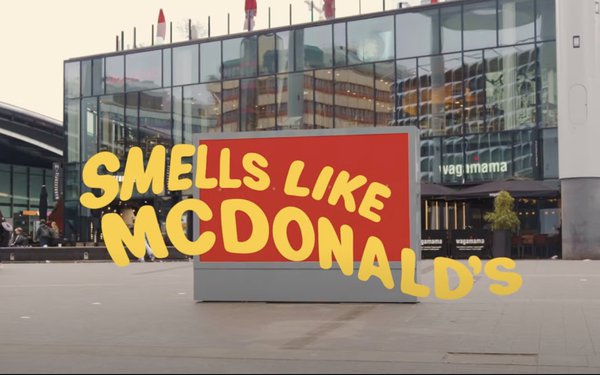
“The plain red and yellow billboards don’t use a single word or image to advertise McDonald’s offerings—and they don’t need to,” according to Fast Company. “Instead, the billboards pump out the aroma of warm french fries to passersby, who seem to instinctively know the scent of a McDonald’s french fry compared to any other form of fried potato.”

I dunno, Doc – kind of reeks of desperation, don’t you think?

– Odor Eater

Dear OE,

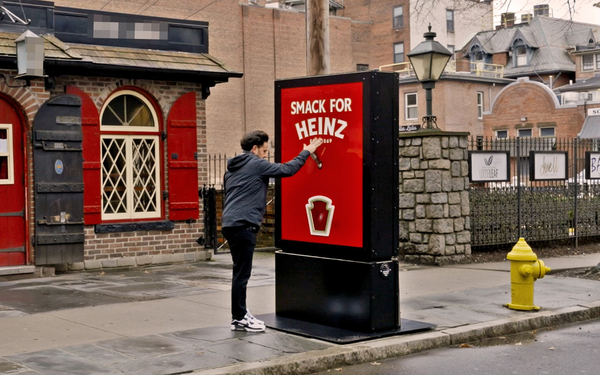
First off, this is shaping up to be the Year of the Billboard, no? It started with smackable billboards that dispense Heinz ketchup packets, as the Doc noted last month. Now it’s smellable billboards, which McDonald’s is promoting with this YouTube video.

The Mickey D billboards represent the olfactory extension of audio spotlight technology employed in supermarket advertising, which Evan I. Schwartz detailed in a 2004 MIT Technology Review piece: “Known as directional sound, it uses an ultrasound emitter to shoot a laserlike beam of audible sound so focused that only people inside a narrow path can hear it.”

Now we have directional smell. Ain’t progress grand. Then again, when someone comes up with Chanel N°Fry, you’ll know they’ve gone too far.

What’s Up With Those Heinz Billboards That Dispense Ketchup Packets?

Well the Doc opened up the old mailbag today and here’s what poured out.

Dear Dr. Ads,

There I was, minding my own business and checking out MediaPost’s Marketing Daily, when I came across Erik Oster’s piece about a new hands-on approach to outdoor advertising.

Heinz Gets Confrontational With ‘Smack For Heinz’ Campaign

At Louis’ Lunch, in New Haven Connecticut, designated by the Library of Congress as the Birthplace of the Hamburger Sandwich itself (although the claim is, at best, unsubstantiated) “no ketchup” is a cardinal rule. Prominently placed signs near the register make the policy abundantly clear, and patrons who have attempted to bring their own bottle into the restaurant have been known to be unceremoniously tossed out of the establishment.

The historic hamburger hangout is just one of the places targeted as part of a “Smack For Heinz” campaign running across film, OOH, digital and social media elements on Instagram and TikTok. The brand installed “smackable billboards” that dispense ketchup packets outside restaurants known for their rules against the condiment.

I dunno, Doc. Is that how you want your condiments delivered? What’s next – a block of salt, a hammer, and a chisel?

– Talkin’ Smack

Dear TS,

Just to establish a baseline, that’s the sugar pourer in use at the Doc’s house. So we’re not exactly new-fangled in matters such as this one. Or slap-happy.

Regardless, here’s the Heinz spot, which begins outside Louis’ Lunch. According to MediaPost, “it appears the restaurant may have been closed during filming — and the billboards appearing in the initial launch video weren’t around for  long.  According to the New Haven Register, the billboard briefly appeared outside the restaurant on March 7, but was quickly removed.”

The ad also features several ketchup-scorning Chicago hot dog joints. According to Carolyn’s Cooking, a true Chicago-style hot dog is “topped with yellow mustard, bright green sweet pickle relish, chopped white onion, tomato wedges, a dill pickle spear, sport peppers and celery salt.” Not a ketchup bottle in sight.

As for Louis’ Lunch, here’s what the burger place says about its ketchup-busting policy.

Louis’ Lunch is committed to serving a classic hamburger that is made with a proprietary blend of five cuts of meat, ground fresh daily. We want you to experience the meat’s true flavor, so we serve it on white toast and only offer cheese, onion, and tomato as garnishes.

One person on Reddit said, “we were told that there was no ketchup in the 1800s so we couldn’t have it now.”

As Layla Schlack reports at the New Haven Register, “people will be able to use the website smackforheinz.com . . . to report restaurants that don’t serve Heinz ketchup. The company will set up the pop-up signs that dispense packets at a select number.” (That website is currently a placeholder, presumably until the official campaign’s debut on April 2nd.)

The Doc’s diagnosis: Smack For Heinz works on the billboards, but the website should really be snitchforheinz.com. Or would that leave a bad taste?

Why Are TV Stations Across America Rejecting PETA’s ‘Tame’ New Ads?

Well the Doc opened up the old mailbag today and here’s what poured out.

Dear Dr. Ads,

There I was, minding my own business and clicking through MediaPost, when I came across this story in Richard Whitman’s MEDIApsssst column.

New PETA Ads Expose How Product R&D Causes Extreme Animal Suffering

PETA [People for the Ethical Treatment of Animals] is out with new ads showing in graphic detail how animals suffer as the result of lab experiments by companies testing new products.

Because experiments on monkeys are so gruesome that no TV station would air them, PETA used CGI to create a new TV spot that reveals who pays the biggest price for pharmaceutical drugs tested on animals. The ads clearly make their point, and many outlets still refuse to air them even though no animals were used in the production effort.

According to PETA, TV stations refusing to run the animated video ads still call them “too graphic” and cite probable “viewer complaints.”

What do you think, Doc – is this just one more example of the animal rights group being too extreme for its own good?

– RePETA

Dear RP,

Plug PETA tactics counterproductive into the Googletron and you get results like these.

According to its latest press release, though, that’s the kind of response the PETA peeps now hope to avoid – to little avail, as it turns out.

‘Too Graphic’: TV Stations Block Tame PETA CGI Spot Aimed at Monkey Laboratories

Because experiments on monkeys are so gruesome that no TV station could possibly air them, PETA used CGI to create a new TV spot that reveals—without showing any real animals, gore, or blood—who pays the real price for pharmaceutical drugs tested on animals. But many TV stations are still refusing to run even this PG-rated, animated video, calling it “too graphic” and “triggering” and citing probable “viewer complaints.”

In the 15-second spot, a “customer” wants to know how much a prescription will cost—and a computer-generated monkey, tattooed with an ID number and wheezing through a breathing tube, has the answer: “Too much.” The video is part of a new series from PETA that also takes on the hefty price animals pay for cheese and cashmere. These two ads are slated to run widely on TV and movie screens throughout the holiday season.

First, judge for yourself whether this pharmaceutical testing spot is “too graphic.”

The Doc’s diagnosis? Pretty tame indeed, given a current mediascape that routinely features bloodthirsty video games, Elon Musk’s demented X-Man cosplay, and constant casual cruelty across all social platforms. Then again, you can’t tell by looking that the monkey is CGI-generated. Ditto for the goat in this cashmere spot.

As for PETA’s assertion that the ads “are slated to run widely on TV and movie screens throughout the holiday season,” let’s go back to Richard Whitman’s MediaPost piece.

PETA says the monkey ad was rejected by multiple TV stations in Indianapolis, Reno and Sacramento.

Only a few individual stations agreed to run the ad in San Diego, Madison, Wisconsin and San Antonio, the latter two near federally funded primate research centers. Also some local stations via Comcast in the Hartford, metro area aired it in time for the Harvard-Yale football game last weekend.

More stations agreed to air the videos in which a computer-generated calf chained up behind a shop’s register and swarming with flies reveals that a wedge of cheese costs “too much.” The group investigated Daisy Farms production methods.

That ad and the cashmere spot “are running on area networks in Charleston, South Carolina, Colorado Springs and Sacramento. Additionally, the calf video will be seen at movie theaters in Sacramento and San Antonio. Altogether, PETA’s ‘Too Much’ videos will air nearly 13,000 times on screens across the country.”

So that’s not nothing. But it’s pretty clear that PETA-bred messages will continue to be muffled, no matter how tame the mistreated animals might be.

Is a Trump-Aligned Super PAC Ad Lying About Ron DeSantis?

Well the Doc opened up the old mailbag today and here’s what poured out.

Dear Dr. Ads,

There I was, minding my own business and checking out the news on MediaPost when I came across Wayne Friedman’s piece about a new ad campaign funded by a Donald Trump-supported Super PAC. It attacks Florida governor (and likely Trump presidential rival) Ron DeSantis for his voting record in Congress on Medicare and Social Security.

A Republican-backed TV commercial campaign is targeting Florida Governor and potential Presidential candidate Ron DeSantis, backed by Donald Trump’s “Make America Great Again” Super PAC . . .

The spot — called “Think You Know Ron DeSantis” — talks about how he has backed “deep cuts to social security and medicare” and says that when he was in Congress, DeSantis voted to raise the retirement age to 70. The bottom-line message, according to a voiceover, is that DeSantis “doesn’t share our values” and that “he is just not ready to be President.”

DeSantis is currently on a book tour saying he’s all about protecting Social Security and Medicare. What gives, Doc?

– Ron Conned?

Dear RC:

It is a fact well-established that Donald Trump and his merry band of remoras (a.k.a. suckerfish) are severely allergic to the truth (according to a Washington Post tally, the Cheeto in Chief alone made 30,573 false or misleading claims during his four years in office).

Against that backdrop . . .

The reported $1.5 million ad campaign (most of it spent on Fox News ads) claims that Ron DeSantis, while a congressman representing Florida’s 6th Congressional District from 2013 to 2018, “voted three separate times to cut Social Security . . . Worse, DeSantis voted to cut Medicare two times. DeSantis even voted to raise the retirement age to 70.” (You can see the spot here.)

So the question is: True? False? Alternative facts?

According to a PolitiFact piece by Yacob Reyes in the Tampa Bay Times last month, it’s not all that cut and dried.

In 2013, with Republicans controlling the House, DeSantis joined 103 Republicans on a failed resolution that called for raising the age to qualify for Medicare and Social Security to 70, according to a Committee for a Responsible Federal Budget analysis.

The measure also supported a transition of Medicare, a program funded by the federal government, to a premium support system, for which the federal government would designate a pot of money for each beneficiary to spend on a private insurance plan.

The resolution’s text stated the measure would have affected future beneficiaries; it says, “those in or near retirement will see no changes.”

A PolitFact piece by Amy Sherman five years ago, which addressed similar charges against DeSantis during Florida’s 2018 GOP gubernatorial primary, labeled them Half True:: “[The non-binding resolutions] were a cut in terms of the programs’ future growth relative to the baseline. But the goal of these resolutions was to persuade Congress to make changes to shore up these programs in the future to avoid steeper cuts down the road.”

Bottom line: Those votes cut no budgets, nor did they reduce seniors’ benefits.

Regardless, DeSantis is doing his best nowadays to rewrite his position on entitlement cuts, as the Tampa Bay Times piece noted.

“Look, I have more seniors here than just about anyone as a percentage,” DeSantis told Fox News’ Dana Perino on March 2. “You know, we’re not going to mess with Social Security as Republicans. I think that that’s pretty clear.”

(As if he didn’t represent seniors for the six years he was Florida’s 6th District congressman. But why get technical about it.)

What’s also pretty clear is that the Trumpiacs will keep touting half-truths about DeSantis as long as he remains a threat to the ex-president’s bid to regain the White House.

The Doc’s prescription: Just because in this instance the MAGAts have downshifted from outright lies to partial ones, we don’t recommend getting used to it.

How Many Lost Advertisers Does It Take To Screw Twitter?

Well the Doc opened up the old mailbag today and here’s what poured out.

Dear Dr. Ads,

There I was, minding my own business and reading Joe Mandese’s MediaPost column, when I came  across this item about Twitter, consumer brands, and public opinion.

While its new owner Elon Musk has blamed pressure groups — as well as advertisers themselves — for discontinuing advertising on Twitter, half of American consumers believe it was the right thing to do since he acquired the company and began making it an even more toxic place for brand marketers and consumers alike.

According to a survey of 500 U.S. adults fielded by Pollfish  on Tuesday, 49% agree with the decisions of big brands to halt their Twitter ad spending, while 27% said they do not agree with their decision and 24% said they’re not sure.

Seeing as how Twitter has normally gotten about 90% of its revenue from ad sales, that’s gotta leave a mark, eh Doc?

– Tweet Dreams

Dear TD,

Yeah, that survey just adds insult to (financial) injury.

Start with Musk’s whining about activist groups pressuring advertisers to ghost Twitter. As CNBC’s Lora Kolodny and Jonathan Vanian have reported, Musk claims that a coalition of activist groups “broke an agreement with him by encouraging companies to halt advertising on Twitter.”

Here’s the dispute in a nutshell, compliments of Patrick W. Watson.

As the CNBC piece noted, those activist groups actively disagree.

Derrick Johnson, CEO of the National Association for the Advancement of Colored People, said in response to Musk’s claims on Tuesday that the civil rights groups “would never make such a deal” and that “Democracy always comes first.”

“The decisions being made at Twitter are dangerous, and it is our duty, as it has been since our founding, to speak out against threats to our democracy,” Johnson said. “Hate speech and violent conspiracies can have no safe harbor.”

Gay & Lesbian Alliance Against Defamation, Free Press, and the Simon Wiesenthal Center all say ditto.

So there’s that.

And then there’s this, according to NPR’s Halisia Hubbard.

Twitter has lost 50 of its top 100 advertisers since Elon Musk took over, report says

Half of Twitter’s top 100 advertisers appear to no longer be advertising on the website. A report from Media Matters for America states that these 50 advertisers have spent almost $2 billion on Twitter ads since 2020 and more than $750 million just in 2022.

Seven additional advertisers have slowed their advertising to almost nothing, according to the report, which was published on Tuesday. These companies have paid Twitter more than $255 million since 2020.

And perhaps the unkindest cut of all for our very own Muskie Muskrat is this Joe Mandese post at Red, White, and Blog.

Vox Populi, Vox Dei: Musk Won’t Own Twitter Much Longer

If the voice of the people really is the voice of God — as Elon Musk keeps tweeting — then he won’t own Twitter much longer.

According to a survey conducted by Pollfish for MediaPost on Tuesday, most American adults do not believe Musk will even own Twitter more than a year.

While a third believe he will own the social media platform a year or more, most consumers believe it will only be “a few months” or “until something else catches his fancy.”

So, will Musk and Twitter crash and burn?

Maybe even prob-a-bool.