Can RFK Jr. Really Make Pharmaceutical Commercials Too Costly to Run?

Well the Doc opened up the old mailbag today and here’s what poured out.

Dear Dr. Ads,

There I was, minding my own business and reading Brian Stelter’s Reliable Sources newsletter, when I came across this item about the latest incarnation of Health and Human Services head Robert F. Kennedy Jr.’s jihad against Big Pharma.

Robert F. Kennedy Jr.‘s HHS is weighing a pair of policies cracking down on direct-to-consumer drug ads by making them more costly to produce. The rules could potentially “leave broadcasters in financial straits,” as they would choke off a crucial revenue source, CNN’s Liam Reilly and Tami Luhby report. Full story here…

What the hey, Doc – will RFK Jr. stop at nothing to land his white whale?

– Bitter Pill

Dear BP,

As you might have noticed, the Doc has been on Bobby Brainworm (pat. pending) like Brown on Williamson for months now over his Just Say No to Drug Ads campaign. Here’s the latest brainstorm from RFK Irregular, as detailed by CNN’s Liam Reilly and Tami Luhby.

While not an outright ban, the two policies would make it significantly more difficult and expensive for drug companies to push their products across broadcasters’ airwaves, according to a Bloomberg report on Tuesday. The policies look to either mandate that advertisers elaborate on the risks posed by their drugs — forcing ads to be longer and, therefore, more expensive — or bar drugmakers from writing off direct-to-consumer ads as business expenses on their taxes, also padding the bill, Bloomberg reported.

We’re talking real money here, folks: “Companies spent $10.8 billion in 2024 on direct-to-consumer pharmaceutical advertising in total, according to a report from the advertising data firm MediaRadar,” says Rachel Cohrs Zhang in her Bloomberg piece.

A whopping 59% of that money goes to TV spots. Case in point: “AbbVie alone spent $2 billion on direct-to-consumer drug ads last year, primarily on advertising for the company’s anti-inflammatory drugs Skyrizi and Rinvoq.”

Representative sample . . .

Annoying? Perhaps. Lucrative? Definitely. “The medicines brought in more than $5 billion for AbbVie in the first quarter of 2025.” That’s $5 billion in three months (annualized return on investment: 1000%) for those of you keeping score at home.

Meanwhile, “Senators Bernie Sanders and Angus King [have] introduced a bill to ban all prescription drug advertising,” according to Chris Williams at Fox News, thereby taking on both the pharmaceutical and broadcast industries.

Wake me when people start saying, “Doctor, I don’t see spots before my eyes.”

How Long Can Pharmaceutical Advertisers Keep Telling the FDA to Screw Off?

Well the Doc opened up the old mailbag today and here’s what poured out.

Dear Dr. Ads,

Long time reader, second time writer . . .

There I was, still minding my own business four months after the Food and Drug Administration introduced new restrictions on pharmaceutical ads, when I came across Emma Yasinski’s piece at the non-profit MedShadow Foundation, asking whether the new FDA guidelines were making a difference in the five billion dollars worth of national television advertising bombarding U.S. consumers every year.

The FDA’s new rules establish guidance to ensure that TV and radio ads clearly communicate the risks and benefits of medications. They recommend measures such as keeping text on screen long enough to read, minimizing distractions from images and audio, and other strategies to help viewers fully grasp how a drug may affect them.

Still, this guidance—nearly 15 years in the making—warrants a closer look, especially given [HHS Secretary Robert F. Kennedy Jr.’s] stance that direct-to-consumer drug commercials should be eliminated entirely.

It’s also worth asking: Will it bring real change to the drug ads we’ve grown so accustomed to during commercial breaks?

According to at least one expert, the answer to that question is simple: No.

Looking for a second opinion on the state of the Pharmaceutical Distraction Machine (PDM), Doc. Any encouraging symptoms?

– On My Meds

Dear OMM,

If there’s been a measurable effect of the new FDA guidelines on prescription drug advertising, you can’t tell by looking.

Case in point: This national TV spot for Ponvory, “a once-daily pill for adults with relapsing MS [multiple sclerosis].”

PDM Index: Off the charts. primarily owing to a scene where Animated Girl runs about and nimbly climbs metal stairways while a sweet-voiced female announcer says, “Ponvory can increase your risk of serious infections that can be life-threatening and may cause death.”

Got that? Probably not – which is, of course, the whole point.

So how, you might ask, is the FDA supposedly enforcing its new advertising guidelines? Here’s how MedShadow’s Emma Yasinski describes the system.

:If the FDA determines that a company’s advertisements violate their updated standards, it can issue one of three types of letters: an It Has Come to Our Attention (IHCTOA) letter, an Untitled letter, and a Warning letter . . . A Warning letter is the most serious type of letter the FDA can send. It details violations and allows companies to respond and correct their violations within 15 days (or explain why it’ll take longer than that), before the agency takes enforcement actions, such as seizing supplies of the drug or taking the company to court.

But . . . “[FDA officials] have declined to say whether enforcement will go beyond issuing advisory letters—recommendations that, for now, carry no direct consequences for companies that choose to ignore them.”

Which is exactly what the companies are doing, to all appearances.

The Doc’s diagnosis: RFK Jr. wants to ban prescription drug ads; Donald Trump wants to gut the FDA, as Alexis Sterling detailed at the progressive website Nation of Change. Here’s betting that the Pharmaceutical Distractionb Machine keeps chugging along, despite any other mishegoss that rains down on the FDA.

Why Is a Veteran Pharma Ad Copywriter Campaigning Against Pharma Ads?

Well the Doc opened up the old mailbag today and here’s what poured out.
Dear Dr. Ads,

There I was, minding my own business and checking out MediaPost’s Pharma & Health Insider, when I came across Les Luchter’s piece about the latest alarms over the “harmful outcomes” that prescription drug advertising has on consumers.

Since 2014, nonprofit RxBalance has been battling what it calls the “undue influence” of pharma marketing by running its own campaigns with such partners as Georgetown University for “Are You Prescribing Under the Influence? “[of pharma], targeted largely at healthcare providers.

Now, RxBalance has begun focusing more on telling the general public how pharma marketing can be less than transparent.  It recently launched an effort against costly Medicare drugs, focusing in particular on evidence that Eliquis from Bristol Myers Squibb/Pfizer’s Eliquis is no more effective than generic Warfarin in preventing strokes caused by atrial fibrillation — despite ad boastsof being “a better treatment.”

I dunno, Doc – is this just another do-gooder whistling past the – ahem – graveyard? Maybe RxBalance should team up with Robert F. Kennedy Jr., assuming Bobby Brainworm actually gets to run the Department of Health and Human Services.

– Drug Story

Dear DS,

For starters, the Doc already dealt with RFK 2.0 and his pipe dream of banning pharmaceutical advertising on TV.  So that’s a dead letter. (Maybe he can lay it out in Central Park in the dead of night, yeah?)

It’s hard to imagine that a bunch of civilians will have any better luck, but RxBalance founder Lydia Green told P&H Insider that she sees signs the landscape might be shifting for Big Pharma.

A lot of what we’ve been doing over the last 10 years is trying to convince people of things they find hard to believe [such as] that a doctor would make a decision…based on something that a sales rep told them. Now it’s much easier. So many of the concepts embedded in care right now were not established 10 years ago. And the pandemic created a sense of distrust in authority. People are much more open to our message.

People, sure. Federal regulators? Maybe not so much.

Even so, Green dreams on: “I personally would be happy to see no pharma advertising, and no brand awareness advertising.” Ditto for the folks at Jacobin, “a leading voice of the American left, offering socialist perspectives on politics, economics, and culture.”

In a piece headlined Drug Ads Misinform Patients and Raise Health Care Costs, Helen Santoro reported that according to one study, “drugmakers spent almost $16 billion over [a] six-year period to advertise products that didn’t provide at least moderate health benefits compared with existing therapeutic options.”

What the ads did provide, however, was a fantastic bang for the buck, as Santoro notes. “[A] report by Intron found that the return on investment from direct-to-consumer drug ads is incredibly high, ranging from 100 to 500 percent.”

So there’s that . . .

The Doc’s prescription: Keep hitting on that hopium, all you reformers. But don’t operate any heavy machinery while doing it.

Is the ‘Ban Pharmaceutical Advertising’ Crowd on Drugs or Something?

Well the Doc opened up the old mailbag today and here’s what poured out.

Dear Dr. Ads,

There I was, minding my own business and starting to paw through the New York Times, when I saw Rebecca Robbins’ front-page story about incoming Trump administration officials looking to euthanize pharmaceutical ads on TV.

Since the late 1990s, drug companies have spent tens of billions of dollars on television ads, drumming up demand for their products with cheerful jingles and scenes of dancing patients.

Now, some people up for top jobs in the incoming Trump administration are attacking such ads, setting up a clash with a powerful industry that has long had the courts on its side.

Robert F. Kennedy Jr., President-elect Donald J. Trump’s choice for health secretary, is a longtime critic of pharmaceutical advertising on TV, arguing that it leads broadcasters to more favorable coverage of the industry and does not improve Americans’ health. He has repeatedly and enthusiastically called for a ban on such ads.

What’s your professional opinion, Doc? Could Bobby Brainworm succeed where so many others have failed?

– On My Meds

Dear OMM,

Let’s start with a short history lesson, shall we?

Back in the ’90s, when the Food and Drug Administration first allowed pharmaceutical advertising to run on television, the ads could say the name of the drug but not what it did, or say what it did but not its name.

It was very Old Testament.

In 1997, though, the FDA bowed to the First Amendment and loosened it restrictions, “[allowing] drug manufacturers to describe the benefits of the drugs without providing long, detailed notices of the side effects. Instead, the F.D.A. said, the drug companies would be required to include in the advertisements a ‘brief summary’ of the major risks,” according to a Times piece that year.

Prescription drug commercials quickly developed a format to meet that requirement: The first half of the spot featured happy people living happy lives thanks to the wondrous effects of the drug; the second half featured a monotone voiceover intoning Contradictions & Side Effects (“Do not take Superion if you are allergic to it; side effects include headache, sudden death, something something something”) while images of windsurfers or giraffes or marching bands cranked up the Big  Pharma Distraction Machine.

(Nowadays, the Doc’s exposure to pharmaceutical commercials is largely limited to the ones that run on The Tennis Channel, most of whose viewers seem to be a) plagued by skin rashes, b) chronically short of breath, or c) allergic to whatever food their companion is enjoying.)

Those freewheeling days, however, appeared to be over when the FDA issued new rules for disclosure in the roughly $5 billion Big Pharma is slated to spend on national television advertising this year.

The Food and Drug Administration (FDA, the Agency, or we) is issuing a final rule to amend its regulations concerning direct-to-consumer (DTC) advertisements (ads) for human prescription drugs presented in television or radio format and stating the name of the drug and its conditions of use (DTC TV/radio ads). Specifically, the final rule implements a requirement of the Federal Food, Drug, and Cosmetic Act (FD&C Act), added by the Food and Drug Administration Amendments Act of 2007 (FDAAA), that in such DTC TV/radio ads, the major statement relating to side effects and contraindications must be presented in a clear, conspicuous, and neutral manner.

Drive PhRMA nuts graf: “In ads in TV format, the information presented in the audio portion of the major statement must also be presented concurrently in text for a sufficient duration to allow it to be read easily. In ads in TV format, the information in text must be formatted such that the information can be read easily. The ad must not include audio or visual elements during the presentation of the major statement that are likely to interfere with comprehension of the major statement.”

Loose translation: No more giraffes!

Except . . .

In our admittedly unscientific survey, there ‘s been only one minor change in prescription drugs ads since the FDA’s drop-dead date of November 20: the addition of small type at the bottom of the screen during disclosure. Other than that, the distraction machine grinds on.

The Doc’s diagnosis: If the federal government can’t even effectively regulate pharmaceutical advertising on television, it sure as hell doesn’t seem capable of banning it outright.

Someone send RFK Jr. some migraine medication, wouldya?

Who’s Coughing Up the Cash for Full-Page Ads Touting Robert F. Kennedy, Jr.?

Well the Doc opened up the old mailbag today and here’s what poured out.

Dear Dr. Ads,

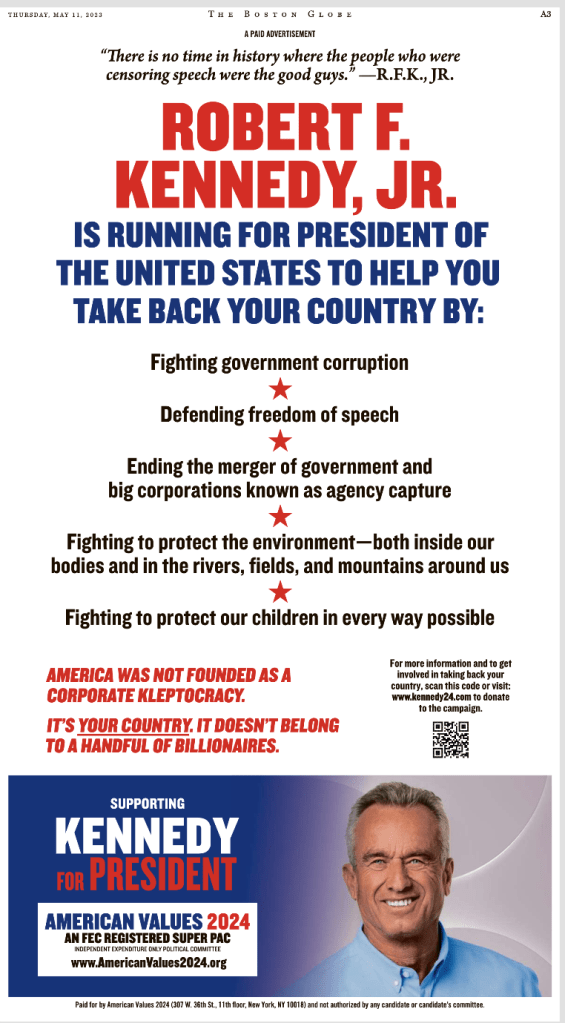
There I was, minding my own business and flipping through the Boston Globe, when I came across this full-page ad on A3.

What the hell, Doc – this guy’s calling card is his anti-vaccine jihad, but no mention of it in this costly  five-figure advertisement? Is the Super PAC just trying to inoculate him?

– Vax Vexed

Dear VV:

First of all, you gotta admire any full-page ad in a major metropolitan newspaper that starts off with a quote about being silenced.

Beyond that, now that we know who the bad guys are, let’s take a look at the purported good guys, starting with the outfit that paid for the ad, American Values 2024. Its website fails to list any of the Super PAC’s good guy funders, but it does showcase Our Team.

The website also spotlights the bad guys at ABC News.

ABC News makes a point of letting viewers know they censored RFKJ

ABC News made a bizarre announcement that they censored RFKJ’s statements about COVID, vaccines and autism following an interview with him on Thursday, 4/27 that included a discussion of the ongoing censorship of him by the corporate media.

“We should note that during our conversation, Kennedy made false claims about the COVID-19 vaccines,” ABC interviewer Linsey Davis said following the interview. “We’ve used our editorial judgment in not including extended portions of that exchange in our interview.” Davis added.

At this point we will just quote Kennedy, “Show me where I am wrong.”

The group helpfully provides video of the offending segment.

Finally, there’s this boilerplate about the Super PAC.

(John Gilmore’s website provides exactly zero additional information.)

The American Values 2024 Twitter feed  (70 tweets, 301 followers) isn’t much help either.

But elsewhere on Twitter, the Super PAC has gotten a modicum of attention.

About a week ago, Slate’s Jim Newell took a look at those polling numbers.

Kennedy officially launched his Democratic primary bid on April 19, after a month or two of making noise about it. In an April 9 Morning Consult poll, 10 percent of those surveyed said they would support Kennedy for the Democratic presidential nomination. The day of Kennedy’s launch, a USA Today/Suffolk poll had Kennedy at 14 percent. The Fox News poll released April 26, referenced by CNN, showed Kennedy at 19 percent. Kennedy was at 21 percent in an April 27 Emerson College poll . . .

It’s not just Kennedy who has a little bit of traction, though. Marianne Williamson, in her second consecutive Democratic primary, is registering in polls as well. In the Fox News survey, Williamson was polling at 9 percent. She was at 8 percent in the Emerson poll.

The main reason these two eccentrics have a surprising primary polling foothold against an incumbent president, then, is because they are the only two warm bodies giving it a go against a president who a supermajority of Americans believe should not run for president again.

One final note: The Bulwark’s Jonathan V. Last asks, Why Is This Man Running as a Democrat?

If you haven’t read Mona [Charen’s] fantastic piece about RFK Jr., go do that right now.

For me, the most interesting question is: Why is this guy running as a Democrat?

As Mona demonstrates, RFK Jr.’s biggest fans seem to come from conservative world. He’s a Fox News / InfoWars kind of candidate . . .

And RFK Jr. is much closer to Alex Jones and Trump and even DeSantis than he is to Bernie Sanders or any other Democratic figure . . .

[It] seems possible that if DeSantis hollows out, the opening isn’t for Nikki Haley, or Tim Scott, or Brian Kemp—it’s for someone like RFK Jr., or Elon Musk, or Alex Jones to take from Trump by making him look like part of the establishment.

The Doc’s diagnosis? Forget Covid boosters – get yourself a Dramamine drip and settle in for the long run.

P.S. Still no idea who’s bankrolling American Values 2024, but it’s bound to come out sooner rather than later.