Why Is Meta Letting Chinese Ad Scammers Rip Off Its Users For $3 Billion/Year?

Well the Doc opened up the old mailbag today and here’s what poured out.

Dear Dr. Ads,

There I was, minding my own business and checking out Brian Stelter’s Reliable Sources newsletter, when I came across this item about the latest tech world ad scam.

‘Meta tolerates rampant ad fraud from China…’
“…to safeguard billions in revenue.” That’s the headline on a new Reuters investigation by Jeff Horwitz and Engen Tham that relies heavily on internal documents. The reporters found that Meta “decided to accept high levels of fraudulent advertisements from China” as the company “wanted to minimize ‘revenue impact’ caused by cracking down on the scams.”

WhatsApp with that, Doc? Strip-mining our data isn’t enough for Mark Suckaberg? Now he’s running Fleecebook and Instascam for Chinese fraudsters?

– Met-ad-verse

Dear M-a-v,

Let’s start with some backstory.

Last week we noted that Meta was one of the tech companies (along with Cash App, Coinbase, Match Group, and Ripple) involved in the Tech Against Scams Coalition, which had just launched a Potemkin marketing campaign purportedly to help consumers identify and avoid online fraudsters. It lasted about as long as a standard WhatsApp message, and had slightly less impact.

We also linked to Jeff Horwitz’s November Reuters piece reporting that “Meta internally projected late last year that it would earn about 10% of its overall annual revenue – or $16 billion – from running advertising for scams and banned goods, internal company documents show.”

Now comes this Reuters follow-up piece that zeroes in on the China connection to Meta’s ad-scam haul. In that case, fraudulent advertising generated not 10%, but 19% of the company’s revenues, or $3 billion of its $18 billion Chinese take in 2024.

Meta’s own internal audits showed that “Meta believed China was the country of origin of roughly a quarter of all ads for scams and banned products on Meta’s platforms worldwide.”  The company set up an anti-fraud team that “slashed the problematic ads by about half during the second half of 2024 – from 19% to 9% of the total advertising revenue coming from China.”

Then Meta Chief Executive Mark Zuckerberg weighed in.

“As a result of Integrity Strategy pivot and follow-up from Zuck,” a late 2024 document notes, the China ads-enforcement team was “asked to pause” its work. Reuters was unable to learn the specifics of the CEO’s involvement or what the so-called “Integrity Strategy pivot” entailed.

But after Zuckerberg’s input, the documents show, Meta disbanded its China-focused anti-scam team. It also lifted a freeze it had introduced on granting new Chinese ad agencies access to its platforms. One document shows that Meta shelved yet other anti-scam measures that internal tests had indicated would be effective.

So, to recap . . .

1) Meta knows.

2) Meta don’t care.

The Doc’s diagnosis: Mark Suckaberg never met a corner he wasn’t happy to cut. Why would he change now?

Did Apple Really Have to Apologize For Its Totally Crushed ‘Crush’ Ad?

Well the Doc opened up the old mailbag today and here’s what poured out.

Dear Dr. Ads,

There I was, minding my own business and poking around Douglas McLennan’s Arts Journal newsletter, when I came across this link.

Apple Apologizes For Horrifying Art-Crushing Ad

– Reuters

I know you wrote about Apple’s ‘Crush’ ad the other day, Doc. What’s up with the company’s moonwalking? Doesn’t Apple have any core convictions?

– Johnny Applecede

Dear JA,

So, to recap: Apple Inc. sought to introduce its new iPad Pro with this ad, set to Sonny & Cher’s “All I Ever Need Is You.”

The immediate reaction was, well, Appleplectic. Actor Hugh Grant actually said it represented “the destruction of the human experience courtesy of Silicon Valley.” When lots of other boldface names piled on, Apple did an about face, as Reuters reported.

Apple apologized on Thursday after an advertisement for its latest iPad Pro model sparked criticism by showing an animation of musical instruments and other symbols of creativity being crushed, Ad Age magazine reported.
“Our goal is to always celebrate the myriad of ways users express themselves and bring their ideas to life through iPad. We missed the mark with this video, and we’re sorry,” Ad Age quoted the iPhone maker as saying.

While the company pulled the ad from TV, Business Insider’s Matt Turner suggests the damage to Apple’s  bottom line will likely be minimal. “First quarter iPad sales came in at $7 billion. In comparison, iPhone sales were almost 10x that. Apple is a $2.8 trillion giant.”

Deadline’s Dominic Patten adds that Apple isn’t really all that sorry, since “after two days they still haven’t taken the literally and figuratively destructive ad down” from its YouTube channel, where it has 2.6 million views so far.

The Doc’s diagnosis: As a news story, this kerfuffle has been dead for three days now. In the end, the whole thing will probably end up ipadding Apple’s sales. Somehow, they always seem to crush it, don’t they?

Is Elon Musk a Twit Who’ll Drive Tesla’s Stock Into a Ditch?

Well the Doc opened up the old mailbag today and here’s what poured out.

Dear Dr. Ads,

There I was, minding my own business and tooling around the interwebs, when I came across this Reuters piece by Lauren Silva Laughlin and Gina Chon.

Elon Musk probably won’t buy Twitter

NEW YORK, April 27 (Reuters Breakingviews) – Four years ago, Elon Musk vowed to set up a peanut brittle company to take on Warren Buffett’s iconic U.S. confectioner See’s Candies. Then he changed his mind. It wouldn’t be surprising if Musk’s $44 billion deal to buy social network Twitter went the same way.

Sure, the Tesla boss was clearly serious about acquiring Twitter as of recently. The financing from Morgan Stanley is shored up. The agreement includes a fee of $1 billion that he – or Twitter – would have to pay if they renege on the contract. And Twitter’s lawyers even wedged in a so-called “specific performance” clause, which could theoretically force Musk to buy the company if he threatens to back out, though in practice this could probably be settled by adding to the break fee.

There are good reasons for him to get cold feet . . .

What do you think, Doc – could Elon have actually musked this up?

– ElonGate

Dear ElonGate,

Let’s check in with Felix Salmon at Axios Capital, who ties Musk’s Twitter bid to his Tesla stock.

Tesla’s stock could fall much further

The recent decline in Tesla stock, possibly caused by worries about Musk’s successful bid for Twitter, has raised concerns that he barely has the liquidity to raise the $21 billion he needs to provide in cash to pay for his new platform.

By the numbers: If you exclude stock that Musk has pledged to secure loans, the value of his freely-sellable Tesla shares is only about $11 billion. In order to find the extra $10 billion, he might have to exercise some of his stock options. That’s expensive, since he’d need to pay income tax, rather than lower long-term capital gains tax, on such sales.

  • What goes down can go down much further: Tesla stock is about 33% below its all-time high. Yet Facebook has performed much worse than that, while rival electric carmaker Rivian is down more than 80%.

A continued decline in Tesla shares could cause margin calls and a lot of forced selling by Musk, which in turn would tend to drive the stock lower still.

The Doc’s diagnosis: Elon definitely might musk everything up.

Your tweet goes here.

What the-? National Enquirer Runs Full-Page Ad in New York Times!

DrAdsforProfileWell the Doc opened up the old mailbag today and here’s what poured out.

Dear Dr. Ads,

There I was, minding my own business and reading Wednesday’s New York Times, when I came across this.


Screen Shot 2014-02-26 at 11.36.49 PM


So, wait a second: The National Enquirer has set up a foundation because they got a story wrong? Don’t they get all their stories wrong?

Whiskey tango foxtrot, yeah Doc?

– Elvis

Dear Elvis,

Hard to believe, isn’t it?

First off, let’s highlight the text for the tiny-type impaired.


Screen Shot 2014-02-26 at 11.37.40 PM

Screen Shot 2014-02-26 at 11.38.04 PM

Screen Shot 2014-02-26 at 11.38.27 PM


Now the back story, compliments of Reuters media critic Jack Shafer.

Supermarket tabloid gets hoodwinked by imposter!!!

The National Enquirer got its nosey-parker proboscis bloodied this month after its big Philip Seymour Hoffman “scoop” was enquirer13-260x300promptly revealed to be a hoax.

Only three days after Hoffman died, the tabloid reported that playwright David Bar Katz — the friend who discovered Hoffman’s dead body — and Hoffman were lovers. It also alleged that Katz watched Hoffman freebase cocaine the evening before his death and had repeatedly witnessed his friend’s use of heroin.

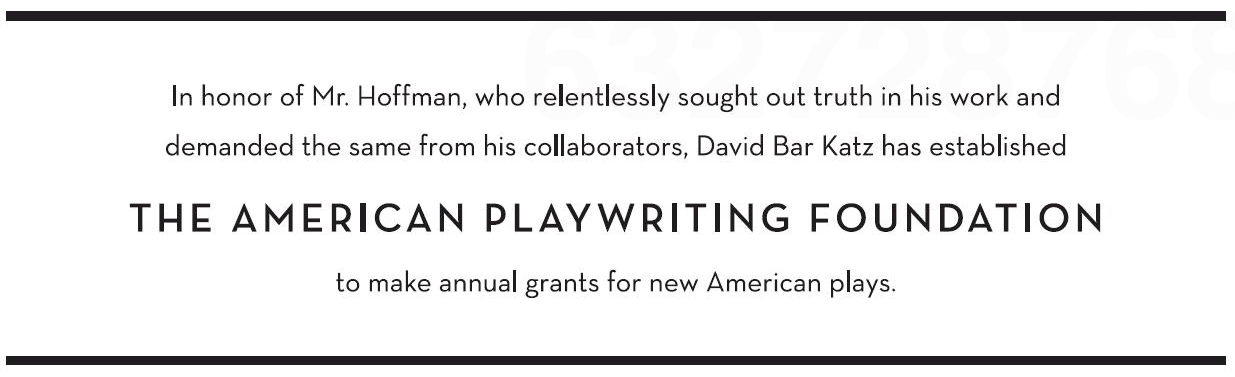
The source for the Enquirer‘s piece? Katz himself, according to the tabloid. But when Katz immediately stepped forward, denied any such interview took place, denied being Hoffman’s lover, denied having watched him do cocaine or heroin, and sued the Enquirer for $50 million, the newspaper retracted the story and apologized. It has now settled with Katz and will fund a foundation that will make annual grants of $45,000 to unproduced playwrights to honor Hoffman. The Enquirer also took out a full-page ad in today’s New York Times to state that it had been fooled by an imposter who “falsely and convincingly claimed to be Mr. Katz.”

But that’s not all.

The Times not only ran the ad on Wednesday, it also ran this front-page piece:

Truth and a Prize Emerge From Lies About Hoffman

Herding his three younger sons out the door to school on Feb. 5, David Bar Katz was stopped for a moment by his eldest, who was browsing the Internet.26about-alt-tmagSF-v2

“My 14-year-old said, ‘Dad, there’s something online about you and Phil being lovers,’ ” Mr. Katz said. “I said, ‘Phil would get a kick out of that.’ ”

Phil was Philip Seymour Hoffman, the actor and Mr. Katz’s good friend, who had been found dead three days earlier, apparently from an overdose of heroin. Mr. Katz, a playwright, was one of two people who had gone to his apartment and discovered his body.

“Things had already achieved the maximum level of surreality, and I thought this thing online was a big nothing,” Mr. Katz said.

In fact, the article, published by The National Enquirer, was the first pebble of a landslide of malignant fiction that sprawled across the web.

And came to rest in a full-page Times ad.

Yo.


What’s Up with the News Corpse – Er, News Corp – Ad?

Well the Doc opened the old mailbag today and here’s what poured out.

Dear Dr. Ads,

Rupert Murdoch has just split his News Corp empire in two: 21st Century Fox, the entertainment division, and the new News Corp print/publishing division. Wall Street sort of loves it, the New York Post really hates it, but most important – what do you think?

– Pieface

Dear Pieface:

Well you’ve certainly come to the right place to find out what I think. But before we get to that, let’s take your other points in order.

First, the News Corp empire is indeed split, as was officially announced in a two-page newspaper ad this week. Here it is from Monday’s New York Times (must’ve killed Murdoch to fork over major six figures to his arch-nemesis, eh?):

Picture 7


So there you have it – print and publishing on the left, complete with a new News Corp logo; entertainment on the right, complete with the updated 21st Century Fox name.

(Also new: Murdoch’s beleaguered News International has been rebranded as News UK. As Mark Borkowski wrote in The Guardian, “[a]t News Corp we are now witnessing a methodical detoxification of the brand, to allow it to function at its best once again.”)

As for Wall Street . . . well, this Reuters headline says it all:

A sign is seen outside News Corporation building in New YorkFree of newspapers, 21st Century Fox shines

(Reuters) – Wall Street rewarded Rupert Murdoch’s move to create a separate entertainment company, giving 21st Century Fox one of the richest valuations in the media sector on its first day of trading.

Investors had waited for Murdoch to split News Corp, giving its cable, movie and equity stakes in pay-TV assets their own spotlight away from the publishing division.

In the first day of trading as separate entities, “[s]hares in the new 21st Century Fox entertainment operation gained over 2 percent on Monday, or $1.1 billion dollars in market value, from its opening price.”

Shares of News Corp, meanwhile, fell 3 percent.

That’s reason number one the New York Post hates the split.  Reason number two is that the tabloid will have to survive on its own without the entertainment division floating its clockwork annual losses, variously estimated at anywhere between $15 million and $110 million.

Finally, what does the old Doc think about all this?

Well, it’s possible the Murdoch just fell out of love with the print side of his medialith (just jettisoned wife #3 Wendi Deng knows the feeling).

It’s also possible that family and financial advisers finally prevailed upon Murdoch to kick the papers out of the nest to see which ones fly.

That sound you hear is the Post, flapping its arms frantically.

Yo.