 Well the Doc opened up the old mailbag today and here’s what poured out.
Dear Dr. Ads,
There I was, minding my own business and tooling around Xitter, when I came across this post from the always lively and informative David S. Bernstein.
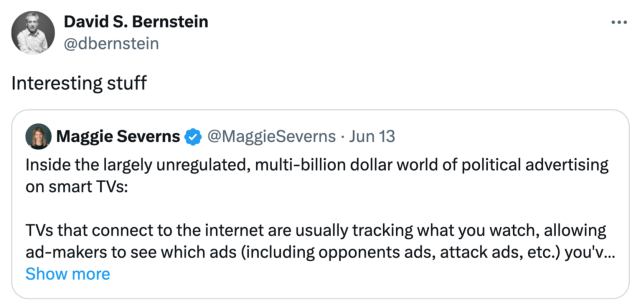
Here’s the rest of Maggie Severns’ post: “. . . you’ve been hit with and how often. Sometimes they can connect TV data to a voter file, or tie your TV to your IP address, allowing ads to follow voters from one screen to another.”
That’s some serious surveillance, yeah Doc? Is that even legal? It sure doesn’t feel kosher.
– Oh Well
Dear OW,
It’s actually worse than you think, as NOTUS reporter Maggie Severns notes.
“Television now watches us more than we watch it,” said Jeff Chester, executive director of the nonprofit Center for Digital Democracy. “The same kinds of strategies used to track and target individuals in order to sell advertising popularized by Google and Meta have been purposely and deliberately exported to the television.”
Televisions that can stream platforms like Hulu or Max usually come loaded with technology that collects information on what viewers are watching, and buyers consent to have their viewing tracked when they open their new TV and click through terms of service agreements. Sometimes, data firms can connect those viewing habits to a voter’s phone or laptop via their IP address, promising a trove of information about an individual and the ability to track them across screens.
In other words, political campaigns can attach themselves to your digital data like Tim Scott to Donald Trump’s tush.
Of course, the question then arises: Does political advertising even work in this day and age? (The Doc diagnosed the current condition of presidential primary ads here.)
On the one hand, according to this piece by New York Times reporter Nick Corasaniti, traditional campaign ads are far less efficient than they used to be.
According to Cross Screen Media, an ad analytics firm, only 63 percent of Iowa Republicans [were] reachable with traditional or “linear” TV ads [this year], as viewers switch to streaming and social media. In 2016, that percentage was still in the 90s. At most, Republican campaigns this year reached 42 percent of likely caucus voters.
On the other hand, as Politico’s Jessica Piper reported, a study by Swayable, a platform used by Democrats to test the effectiveness of different messages and advertisements, was more encouraging: “[The] study’s authors . . . note that the greatest benefits would likely accrue to the best-funded campaigns and groups that can afford to create (and test) many ads in real time, not cash-strapped efforts further down the ballot.”
Either way, traditional television spots are definitely the wave of the past. Which makes the smart TVampires even more attractive to political campaigns, as NOTUS’s Maggie Severns wrote.
Today, more than half of ads booked on traditional television go to target only 11% of swing voters, according to data collected by Cross Screen Media, an analytics firm started by GOP operative Michael Beach.
Cross Screen Media estimates that close to 40% of video advertising budgets — around $4.2 billion — will go to digital ads this cycle, up from about 27% four years ago.
The Doc’s diagnosis: When your TV is smarter than you are, go listen to the radio.
 Well the Doc opened up the old mailbag today and here’s what poured out.

 Ask Doctor Ads