Did the Democrats Really Blow $1.3 Billion On Ads to (Not) Elect Kamala Harris?

Well the Doc opened up the old mailbag today and here’s what poured out.

Dear Dr. Ads,

There I was, minding my own business and reading the latest Semafor Media newsletter, when I came across this item about the 2024 presidential ad bakeoff.

ROI: The 2024 election . . . demonstrated the limits of television advertising. Democrats spent $460 million more on traditional advertising than Trump and still managed to lose handily.

What the hell, Doc – all those dollars and no sense, eh? Shouldn’t the Dems have just set that money on fire?

– Battleground Burnout

Dear BB,

First off, before you start lighting any matches, let’s note this drought-induced ad that ran in the New York Times the other day.

Safety first, yeah?

Meanwhile, here’s the tab (compiled by AdImpact) for all the presidential sturm ad drang this time around, which mostly ran in the seven battleground states.

That’s $1.37 billion vs. $914 million, for those of you keeping score at home.

Then again, maybe not the best investment, as Trisha Oswald and Paul Hiebert pointed out in Adweek,

It’s telling that a recent survey suggests most U.S. adults think there are too many political ads on TV during presidential campaigns.

As Paul Dyer, chief executive of creative agency Prompt, put it, the Democrat’s strategy was to lead with paid media, while the Republicans started with earned media.

Trump’s October appearance on Joe Rogan’s podcast—three hours of unscripted conversation that racked up 26 million views in 24 hours, per Newsweek—was a key moment. During the episode, he also made 32 false claims, per CNN. Trump also embraced the creator economy, teaming up with figures like Jake Paul, whose Instagram video with Trump in a playful moment amassed over 1.5 million likes.

Trump in a playful moment? That’s a phrase the Doc did not have on his bingo card.

Most of that two-plus billion was just costly noise, except for the $100 million that the Trump campaign dropped on a culture-war ad, as Rachel Bachman, Laura Kusisto, and Kris Maher detailed in this Wall Street Journal piece.

The political ad that Donald Trump rolled out in the closing weeks of his campaign was designed to confront voters’ feelings on one of the hot-button cultural issues of our time: transgender rights.

It featured 2019 footage of Trump’s opponent, Kamala Harris, saying she supported taxpayer-funded surgery for transgender inmates. The tagline: “Kamala’s For They/Them. President Trump is for you.”

The message hit the target for voters like Richard Amorose, a 48-year-old Philadelphia general laborer. He cast ballots for Democrats in the past, but these days he thinks the party has lost touch with working-class voters and is “all identity politics.”

“They need to stop a lot of their ideology, meaning like transgender, whatever. I have nothing against them,” Amorose said, but, “stop pushing it down my throat.” Trump flipped the blue-collar ward where Amorose lives from blue to red on Tuesday.

Just for the record, taxpayer-funded surgery for transgender inmates has occurred exactly twice, but why get technical about it when there are hot-button issues to demagogue?

The Doc’s diagnosis: As we’ve said before, presidential TV spots ain’t what they used to be. But that won’t keep the 2028 White House hopefuls from dropping three billion on them next time around.

All those dollars and no sense, indeed.

Did Robots Really Write Kayak’s Latest Ad Campaign?

Well the Doc opened up the old mailbag today and here’s what poured out.

Dear Dr. Ads,

There I was, minding my own business and reading Patrick Coffee’s Wall Street Journal piece headlined “Robots Turn Creative as AI Helps Drive Ad Campaigns,” when I came across this passage.

Kayak worked with New York advertising agency Supernatural Development LLC, whose internal AI platform combines marketers’ answers to questions about their business with consumer data drawn from social media and market research to suggest campaign strategies, then automatically generates ideas for advertising copy and other marketing materials.

Supernatural’s AI found that Kayak should target its campaign largely toward young, upper-income men, who it said would respond to humor about Americans’ inability to agree on basic facts in politics and pop culture, said Michael Barrett, co-founder and chief strategy officer at Supernatural.

Tell the truth, Doc – are robots going to take over the world?

– Robby

Dear Robby,

The Doc doesn’t know from robots taking over the world, but they sure might take over advertising if the Kayak spots are any indication.

As the Journal piece noted, “[most] travel ads focused on ‘the family reunion space, soft piano music, the get-together on the beach,’ said Matthew Clarke, vice president of North American marketing for the Booking Holdings Inc. company. Kayak took a different approach with the ‘Kayak Deniers’ campaign, which went live in January and poked fun at the rise of online conspiracy theories.”

To wit:

Beyond that, there’s this totally depressing news from marketing technology website MarTechSeries.

Waymark, a pioneer in using artificial intelligence to scale up video production, has launched a revolutionary AI-powered tool that allows users to create ads in minutes with no creative expertise required. Waymark AI Video Creator empowers local media companies to instantly create high-quality ads and get them to air quickly, shortening sales cycles and creating new opportunities for growth with local businesses.

So that’s umpteen ad guys and gals soon to be pounding the pavement.

Then there’s Patrick Kulp’s piece in Adweek documenting Heinz-sight in ketchup advertising.

Heinz Taps State-of-the-Art AI to Design Its Next Ad Campaign

Heinz tapped an artificial intelligence-powered art generator to create a clever demonstration of the ubiquity of its brand in the condiment aisle.

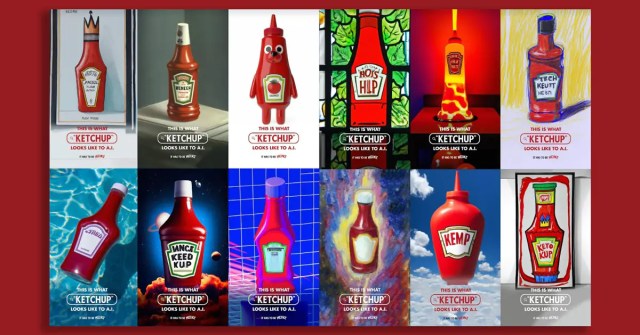
The company’s marketing team fed a series of generic ketchup-related prompts into research group OpenAI’s state-of-the-art machine learning algorithm, Dall-E 2, which conjures up eerily detailed images from simple text inputs.

The results are all over the place—from a Tron-like neon-shaded bottle to a cute container in the shape of a dog—but the one commonality is that most seemed to have adopted the trademark fringe, shape and lettering of a Heinz label.

The Doc’s diagnosis? It’s time for copywriters and art directors to catch up. How they do that, though, might take some machine learning.

Why Is OkCupid Ad Saying OkAbortions?

Well the Doc opened up the old mailbag today and here’s what poured out.
Dear Dr. Ads,

There I was, minding my own business and reading Adweek when I came across this report by Sara Century on the latest wrinkle in online dating.

OkCupid Relaunches ‘Every Single Person’ Campaign to Champion Reproductive Rights

One less-discussed element of the ongoing Covid-19 pandemic is the effect it has had on daters, with the conflicting concepts of social distancing and meeting new people causing trepidation for many. Likewise, a desire to discuss politics has shot up in recent years, creating further obstacles for casual dating.

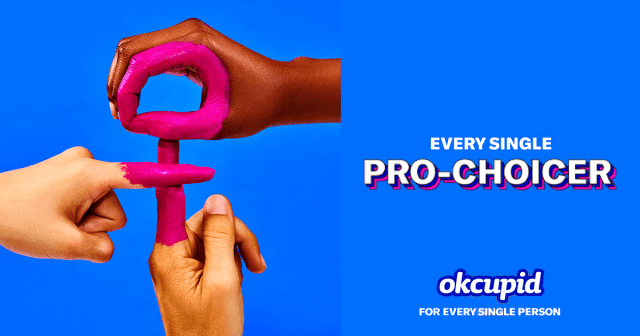
With these barriers in mind, OkCupid is relaunching its “Every Single Person” campaign, which originally kicked off last fall. The brand is doubling down on its mission of inclusivity by adding a new pro-choice line across the NYC subway.

This campaign, which features 17 images, is the result of OkCupid’s 12-month effort to understand gender and identity in order to utilize technology that will appeal to as wide a variety of communities as possible. Brainstormed by OkCupid’s CMO Melissa Hobley and Devin Colleran, it features art by Maurizio Cattelan and photography by Pierpaolo Ferrari.

The dating service has even joined with Planned Parenthood “to create a badge that would assist users in matching with others that supported reproductive rights.”

Most companies wouldn’t associate themselves with the abortion issue at gunpoint. What gives, Doc.

– Are They OkStupid?

Dear ATO,

This one’s a corker, as my former associate Nurse Ads might say. (Nurse Ads is “former” because she’s off actually attending medical school.)

For starters, here are some of the groups that preceded the pro-choicers in the OkCupid campaign.

Fun fact to know and tell: According to Phoebe Bain’s report in Marketing Brew, three of those four ads were just rejected by officials at the Metropolitan Transit Authority, a.k.a. the New York subway system. You can probably guess which ones.

OkCupid’s pro-pro-choice ad comes in the wake of this viral video, which depicts a woman tearing down OkCupid ads on a New York subway train and has been viewed over 1.1 million times on YouTube during the past four months.

Devin Colleran, senior brand manager of OkCupid, told Adweek that “the homophobic rant in response to our campaign only empowered us to double down on our commitment to celebrate all kinds of identities and love both in our app and our marketing.”

As for abortion being the third rail for marketers, MediaPost’s Sarah Mahoney reports that “it’s all part of the brand’s ongoing mission to have users bring their entire selves to the dating process.”

“We want you to bring your issues — pun intended — to dating,” says Melissa Hobley, chief marketing officer. “That can include unapologetically supporting abortion. We want to make it ‘hot’ for people to commit to those issues to our dating app. If you’re pro-choice — and the majority of the country is — and can’t imagine dating someone who isn’t, then that’s a real and relevant issue.”

Real, relevant, and . . . risky.

Then again, that’s OkCupid’s choice

Got a 2013 Top Ten for Us, Doc?

DrAdsforProfileWell the Doc opened up the old mailbag today and here’s what poured out.

Dear Dr. Ads,

I’ve noticed that a lot of media outlets have picked their Top Whatever Ads of 2013 in recent days.

There’s Adweek’s Mostapalooza featuring The Ten Most Sexist Ads of 2013, The 10 Most Epic TV Promos of 2013, The Ten Most-Viral Ads of 2013, and The Ten Most Watched Ads on YouTube in 2013.

Then there’s USA Today’s Top 5 ads of 2013.

Among many others.

Any way you can sort this out for us, Doc?

– H.D. Dromedary

Dear H.D. Dromedary,

We’re guessing you’d be most interested in Adweek’s 10 Best Ads of 2013, which slots this spot at #4:


But – all due respect – we have to agree with Adweek’s choices for the top three.

Guinness Basketball:


RAM Farmer:


And #1, Dove Real Beauty Sketches:


That’s some moving marketing, yeah?

Yo.