Is the Meta/Coinbase Anti-Scam Campaign Itself Just a Brandwashing Scam?

Well the Doc opened up the old mailbag today and here’s what poured out.

Dear Dr. Ads,

There I was, minding my own business and poking around MediaPost’s Marketing Daily, when I came across Danielle Oster’s piece about a new anti-scam campaign sponsored by a bunch of scam-prone companies.

Tech Against Scams Coalition Serves Up ‘Scamberry Pie’

A group called Tech Against Scams Coalition (TASC) has launched a holiday scam prevention campaign as several companies involved in the group face lingering accusations of inadequate internal fraud prevention.

Launched in 2024, the cross-industry group includes representatives from companies including Cash App, Coinbase, Match Group, Meta, and Ripple. TASC partnered with Stereo Creative and media agency Noble People on the campaign, which the groups say was designed to inspire conversations around online fraud prevention.

According to Oster’s report, the campaign consists of “a social media ad . . . influencer partnerships, a food truck activation in Los Angeles . . . a Primrose Hill Bakery activation in London . . . and partnerships with community-based organizations such as AARP.”

So what are we talking here, Doc – mid-to-high five figures, plus creative fees? Isn’t this whole thing just a bargain-basement play for news coverage?

– Sam the Scam

Dear StS,

From all appearances, you’re right on the money.

Here’s the social media ad . . .

Not to get technical about it, but the video’s “Scam Fast Facts” are on-screen for all of three seconds, and the Scamberry web address appears in the tag for maybe two.

Feels kind of, well . . . scammy?

What’s most likely to happen is that the giveaways will get two minutes one night on local newscasts and the campaign will be over before you can finish your scamberry pie.

Meanwhile, here are some recent headlines you might find relevant.

Meta reportedly projected 10% of 2024 sales came from scam, fraud ads

Lawmakers pressure dating sites as $1.3 billion lost to romance scams each year

Coinbase phishing scams steal $65M in two months . . .

The Doc’s diagnosis: This Scamberry campaign is hardly gonna bury many scams.

Can the Trump Administration Finally Drag Drug Ads Into FDA Compliance?

Well the Doc opened up the old mailbag today and here’s what poured out.

Dear Dr. Ads,

There I was, minding my own business and clicking through the Boston Globe, when I came across Gerry Smith’s Bloomberg piece about a pharmaceutical company that actually did what the Food and Drug Administration said to do about its TV spots.

Alnylam Pharmaceuticals Inc. has stopped airing a TV commercial for its new heart medicine, a sign that the Trump administration’s crackdown on the industry’s ubiquitous drug ads is having an impact on the media landscape.

Alnylam was one of many companies to get letters last month from the US Food and Drug Administration calling out what the agency believes are misleading commercials. Most of the letters, sent to companies including AstraZeneca Plc, Bristol Myers Squibb Co., and AbbVie Inc., detail concerns with their online, broadcast, and print marketing, ranging from hiring actors who appear too healthy to omitting key safety risks.

Whaddaya think, Doc – is the Food and Drug Sadministration finally breaking through after years of being told by drugmakers to screw off?

– Medicine Man

Dear MM,

As TV reporters often say (when they have nothing to say), time will tell. Meanwhile, the Alnylam commercial in question – for the new heart medication Amvuttra – is nowhere to be found on Google or YouTube. According to the Bloomberg piece, however, the spot showed patients who were way too exuberant while “traveling and participating in activities like whale-watching and jumping up and down while cheering at a football game.”

The ad was misleading, the FDA said, because it suggested that patients “can be carefree” about the heart disease that the drug treats.

“The totality of these claims and presentations also misleadingly suggests that treatment with Amvuttra will broadly improve a patient’s overall quality of life when this has not been demonstrated,” wrote George Tidmarsh, the head of the FDA’s Center for Drug Evaluation and Research, on Sept. 9. The company was asked to address the violations, including by halting communications the FDA found misleading.

In response, Alnylam pulled the ad, saying “It’s standard practice to pause advertising while changes are being considered.”

(Actually, it’s kind of not, as the Doc recently chronicled regarding the FDA’s attempted crackdown on “surreal” ads. )

The Alnylam pullback means the FDA is batting .010 so far out of its 100 cease-and-desist letters to pharmaceutical companies.

The Doc’s diagnosis:  Please note that Alnylam has a market cap of around $60 billion compared to, say, Pfizer’s $155 billion. Or AstraZeneca’s $255 billion. Or AbbVie’s $413 billion. So the FDA basically hooked one of the minnows in the Pharma pond. Wake us when they land a big fish, yeah?

How Real Is the FDA’s Tough-Talking Crackdown on ‘Surreal’ Drug Ads?

Well the Doc opened up the old mailbag today and here’s what poured out.

Dear Dr. Ads,

There I was, minding my own business and leafing through the Wall Street Journal, when I came across this piece by Joseph Walker and Suzanne Vranica about the Food and Drug Administration’s latest effort to butch up its oversight of pharmaceutical advertising.

The surreal world of TV pharmaceutical ads, where people with terrible diseases tend to be young, beautiful and living life to the fullestsometimes with animated monstershas been parodied on late night sketch comedy shows.

But the drug industry’s biggest critic may turn out to be government regulators inside the Food and Drug Administration.

The FDA is cracking down on direct-to-consumer ads on the directive of President Trump. The agency issued letters to drugmakers last week, citing misleading storytelling with embellished scenes of picture-perfect health. Companies should cease and desist airing misleading ads, which violate federal law around the marketing of prescription drugs, the agency said.

Seriously, Doc – this is like the umpteenth time the FDA has made threatening noises about cracking down on drug ads, with no visible effect on the Big Pharma Distraction Machine. Why would this be any different?

– Food and Drug Sadministration

Dear FDS,

First off, about that guy and his blobby blue friend . . .

In a Pfizer ad, a young man is sitting on the couch next to a blue-skinned, five-eyed creature who runs to the camera and starts licking the screen like a puppy. The man explains that “this thing” is what’s happening inside of him, an inflammatory bowel disease called ulcerative colitis.

“It wasn’t always this calm,” he says. A flashback scene shows the creature, now blood-red, tearing through his home like a wild animal.

“But then I found out about Velsipity, a new once-daily pill,” the man says, back on the couch in the present day with the more docile blue creature.

Cue the Big Pharma Distraction Machine: “The frames that follow show the relatively well-behaved creature following him around as he enjoys a barbecue with friends,” while the soothing voiceover gently reminds viewers that “Velsipity may cause serious side effects including infections that can be fatal . . . certain types of skin cancer . . . swelling and narrowing of the brain’s blood vessels . . . ” and etc.

See for yourself . . .

According to the Journal piece,  the FDA’s letter to Pfizer (one of “100 letters notifying companies that their ads were out of bounds, compared with just a handful of letters in the past two years”) complained that “the magnitude of change depicted in the visuals implies a greater improvement in clinical remission than had been demonstrated” in studies.

Pfizer’s response? Yeah, whatever. (Two years ago the FDA told drugmakers in no uncertain terms to cut the crap in their direst-to-consumer ads, with up to zero effect.)

This latest regulatory spasm comes hard on the heels of last week’s semi-tough talk from the Trump administration, as the Journal’s Walker and Vranica reported.

The Trump administration is cracking down on pharmaceutical advertising—but stopped short of the worst-case scenario some drug and ad executives feared.

The moves could dent, but not demolish, the massive investment that the industry makes in pitching its products directly to consumers. Advertising, media and drug industry executives say they are relieved the government isn’t pushing for a complete moratorium on the ads, but some remain apprehensive about potential rule changes and their consequences.

(The pharmaceutical industry spends upwards of $11 billion a year on U.S. advertising, for those of you keeping score at home.)

Then again, all those federal crackdown efforts could be as fleeting as toe fungus in a Jublia commercial. As Lizzy Lawrence and Ed Silverman reported at STAT, “experts questioned whether the Food and Drug Administration has the resources to prosecute this aggressive campaign after laying off many of the experienced staff who would lead the effort. ‘What happens when those 100 responses come in, and how is FDA going to prioritize its review of those?’ said Joshua Oyster, a partner at Ropes & Gray. ‘How is the FDA going to prioritize follow-up actions, if any, in response to those responses?’”

The Doc’s diagnosis: Call it the Food and DOGE Administration. Just don’t expect it to answer the phone.

What’s With New Ad Campaigns Featuring ‘White Supremacist Undertones’?

Well the Doc opened up the old mailbag today and here’s what poured out.

Dear Dr. Ads,

There I was, minding my own business and checking out Adweek Daily, when I came across Elena Cavender’s piece about a new Dunkin’ ad that’s gotten critics a bit over-caffeinated.

Dunkin’ Faces Backlash Over Genetics Reference in New Ad

Dunkin’s latest ad, released on the heels of American Eagle’s new campaign starring Sydney Sweeney, is facing backlash on social media for mentioning genetics.

The ad stars The Summer I Turned Pretty star Gavin Casalengo and promotes Dunkin’s Golden Hour Refresher by playing on the actor’s “golden” tanned skin.

The spot came out days after American Eagle’s “Sydney Sweeney Has Great Jeans” campaign, which has drawn criticism for alleged racist undertones and promoting eugenics due to its celebration of Sweeney’s genes . . .

While the Dunkin’ ad’s mention of genetics is subtler, it has struck a nerve for praising traits associated with white beauty ideals while mentioning genetics. In the ad, Casalengo says, “This tan? Genetics. I just got my color analysis back and guess what? Golden summer.”

What’s next, Doc – Starbucks promoting “Flat White Power”?

– Gene Genie

Dear GG,

As much as the umbrage-industrial complex might be condemning American Eagle’s Sydney Sweeney ad “as noninclusive at best and as overtly promoting ‘white supremacy‘ and ‘Nazi propaganda‘ at worst,” the campaign really feels more like the intersection of Lame and Lazy.

Jeans . . . genes? That’s the best you got?

Here are the Sydney Sweeney spots, starting with the one where she says,“‘Genes are passed down from parents to offspring, often determining traits like hair color, personality and even eye color … my jeans are blue,’

You can stop now, American Eagle. That horse is dead, no offense to deceased equines.

As for Mr. I’m Too Pretty in Dunkin’s TV spot, he actually does seem genetically engineered . . . to be as off-putting as humanly possible.

The Doc’s diagnosis: Look for Gavin Casalengo coming soon in Season One of The Summer I Turned Pretty Obnoxious.

Can RFK Jr. Really Make Pharmaceutical Commercials Too Costly to Run?

Well the Doc opened up the old mailbag today and here’s what poured out.

Dear Dr. Ads,

There I was, minding my own business and reading Brian Stelter’s Reliable Sources newsletter, when I came across this item about the latest incarnation of Health and Human Services head Robert F. Kennedy Jr.’s jihad against Big Pharma.

Robert F. Kennedy Jr.‘s HHS is weighing a pair of policies cracking down on direct-to-consumer drug ads by making them more costly to produce. The rules could potentially “leave broadcasters in financial straits,” as they would choke off a crucial revenue source, CNN’s Liam Reilly and Tami Luhby report. Full story here…

What the hey, Doc – will RFK Jr. stop at nothing to land his white whale?

– Bitter Pill

Dear BP,

As you might have noticed, the Doc has been on Bobby Brainworm (pat. pending) like Brown on Williamson for months now over his Just Say No to Drug Ads campaign. Here’s the latest brainstorm from RFK Irregular, as detailed by CNN’s Liam Reilly and Tami Luhby.

While not an outright ban, the two policies would make it significantly more difficult and expensive for drug companies to push their products across broadcasters’ airwaves, according to a Bloomberg report on Tuesday. The policies look to either mandate that advertisers elaborate on the risks posed by their drugs — forcing ads to be longer and, therefore, more expensive — or bar drugmakers from writing off direct-to-consumer ads as business expenses on their taxes, also padding the bill, Bloomberg reported.

We’re talking real money here, folks: “Companies spent $10.8 billion in 2024 on direct-to-consumer pharmaceutical advertising in total, according to a report from the advertising data firm MediaRadar,” says Rachel Cohrs Zhang in her Bloomberg piece.

A whopping 59% of that money goes to TV spots. Case in point: “AbbVie alone spent $2 billion on direct-to-consumer drug ads last year, primarily on advertising for the company’s anti-inflammatory drugs Skyrizi and Rinvoq.”

Representative sample . . .

Annoying? Perhaps. Lucrative? Definitely. “The medicines brought in more than $5 billion for AbbVie in the first quarter of 2025.” That’s $5 billion in three months (annualized return on investment: 1000%) for those of you keeping score at home.

Meanwhile, “Senators Bernie Sanders and Angus King [have] introduced a bill to ban all prescription drug advertising,” according to Chris Williams at Fox News, thereby taking on both the pharmaceutical and broadcast industries.

Wake me when people start saying, “Doctor, I don’t see spots before my eyes.”

How Long Can Pharmaceutical Advertisers Keep Telling the FDA to Screw Off?

Well the Doc opened up the old mailbag today and here’s what poured out.

Dear Dr. Ads,

Long time reader, second time writer . . .

There I was, still minding my own business four months after the Food and Drug Administration introduced new restrictions on pharmaceutical ads, when I came across Emma Yasinski’s piece at the non-profit MedShadow Foundation, asking whether the new FDA guidelines were making a difference in the five billion dollars worth of national television advertising bombarding U.S. consumers every year.

The FDA’s new rules establish guidance to ensure that TV and radio ads clearly communicate the risks and benefits of medications. They recommend measures such as keeping text on screen long enough to read, minimizing distractions from images and audio, and other strategies to help viewers fully grasp how a drug may affect them.

Still, this guidance—nearly 15 years in the making—warrants a closer look, especially given [HHS Secretary Robert F. Kennedy Jr.’s] stance that direct-to-consumer drug commercials should be eliminated entirely.

It’s also worth asking: Will it bring real change to the drug ads we’ve grown so accustomed to during commercial breaks?

According to at least one expert, the answer to that question is simple: No.

Looking for a second opinion on the state of the Pharmaceutical Distraction Machine (PDM), Doc. Any encouraging symptoms?

– On My Meds

Dear OMM,

If there’s been a measurable effect of the new FDA guidelines on prescription drug advertising, you can’t tell by looking.

Case in point: This national TV spot for Ponvory, “a once-daily pill for adults with relapsing MS [multiple sclerosis].”

PDM Index: Off the charts. primarily owing to a scene where Animated Girl runs about and nimbly climbs metal stairways while a sweet-voiced female announcer says, “Ponvory can increase your risk of serious infections that can be life-threatening and may cause death.”

Got that? Probably not – which is, of course, the whole point.

So how, you might ask, is the FDA supposedly enforcing its new advertising guidelines? Here’s how MedShadow’s Emma Yasinski describes the system.

:If the FDA determines that a company’s advertisements violate their updated standards, it can issue one of three types of letters: an It Has Come to Our Attention (IHCTOA) letter, an Untitled letter, and a Warning letter . . . A Warning letter is the most serious type of letter the FDA can send. It details violations and allows companies to respond and correct their violations within 15 days (or explain why it’ll take longer than that), before the agency takes enforcement actions, such as seizing supplies of the drug or taking the company to court.

But . . . “[FDA officials] have declined to say whether enforcement will go beyond issuing advisory letters—recommendations that, for now, carry no direct consequences for companies that choose to ignore them.”

Which is exactly what the companies are doing, to all appearances.

The Doc’s diagnosis: RFK Jr. wants to ban prescription drug ads; Donald Trump wants to gut the FDA, as Alexis Sterling detailed at the progressive website Nation of Change. Here’s betting that the Pharmaceutical Distractionb Machine keeps chugging along, despite any other mishegoss that rains down on the FDA.

Does New York’s SoHo ‘Fertility Concierge’ Really Need a 42-Foot Billboard?

Well the Doc opened up the old mailbag today and here’s what poured out.

Dear Dr. Ads,

There I was, minding my own business and poking around MediaPost’s Marketing Daily, when I came across Les Luchter’s piece about a billboard currently looming over New York’s SoHo neighborhood.

Let’s talk about the high price of eggs these days!

No, not the eggs now selling for more than $9 a dozen in New York City.

Rather, the “fertilized, not scrambled” kind, as touted on an attention-grabbing billboard which went up mid-February in New York City’s Soho neighborhood.

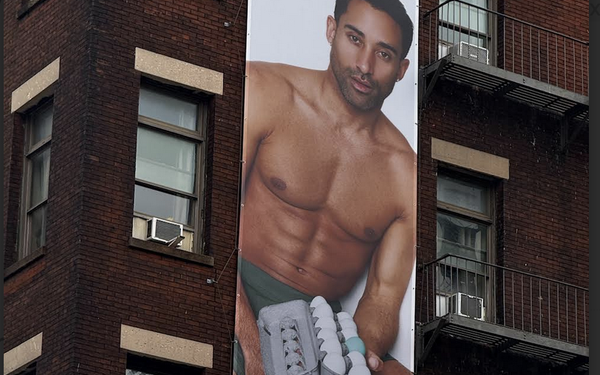
A 42-foot-tall photo of Stefen D’Angelica, best known for his stint on Discovery Channel’s “Naked and Afraid of Love” dating show spinoff, graces the billboard. D’Angelica, clad only in boxer shorts, holds an egg carton over his crotch. Under that, the board reads, “Fertilized, not scrambled.  @getlushi.”

Don’t even know where to start here, Doc. Maybe with the egg carton/crotch thing?

– Egged On

Dear EO,

Yes well let’s start at the beginning.

Lushi, for those of you keeping score at home, is a “fertility concierge platform” for egg freezing and IVF. About its name: “The Lushi is a rare breed of chicken known for laying blue eggs, with only a limited supply produced in its lifetime.”

That mirrors, according to Lushi’s website, “an important truth about women: they are born with all the eggs they will ever have, a finite resource that is both precious and powerful.”

Okay then.

Luchter’s piece also notes this: “D’Angelica is ‘pretty well known in the city as a very eligible bachelor,’ [Lushi founder-CEO Jessica] Schaefer points out, and the billboard has resulted in significant boosts to both Lushi’s website and social media, with ‘very high’ engagement.”

Checking in with the 42-Foot Himbo, a Google search for Stefen D’Angelica Lushi yields two links – one the MediaPost piece, the other an Ads of the World review.

Moving on to your local fertility concierge (available in New York, Los Angeles, Chicago, Boston and Austin), here’s the @getlushi Xitter feed.

(To be fair graf goes here)

To be fair, Lushi’s Tik-Tok feed has five followers.

The Doc’s diagnosis: Seems Lushi’s marketing could use a bit more fruitfulness of its own.

How Much Is FanDuel’s Super Bowl LIX Ad Like Crack Cocaine for Gamblers?

Well they Doc opened up the old mailbag today and here’s what poured out.

Dear Dr. Ads,

There I was, minding my own business and checking out MediaPost’s Marketing Daily, when I came across Danielle Oster’s piece about the new teaser ad for FanDuel’s upcoming Super Bowl commercial/canoodle with the Fox broadcast network.

Former New York Giants quarterback Eli Manning stares at a screen with the word “Destiny” under an image of a football goal post over a cosmic background in the latest teaser for FanDuel’s upcoming “Kick of Destiny 3.”

“They say destiny finds you — unless your dad and brother want you to have a quarterback destiny instead,”  Manning intones in the ad’s voiceover. Eli’s philosophical waxing about destiny is interrupted when his brother Peyton — like Eli, a two-time Super Bowl champion — shows up to ask him what he’s doing, followed by a contentious exchange.

The new teaser’s playful brotherly rivalry tone is meant to stoke excitement for FanDuel’s “Kick Of Destiny 3” Super Bowl ad, and associated programming.

Wait – and associated programming? Yes, indeed.

The Mannings will have a kickathon during the Super Bowl pre-game show, but first “FanDuel [will call] on fans to place a free bet on which brother will win the competition, with winning picks earning an equal share of $10 million in ‘Bonus Bets’ on the platform.” Then FanDuel’s two spots during the game will recap the competition.

Look, Doc, I know the corn is off the cob, and the days of Super Bowl ads that were standalones  – paid (through the nose) commercials that ran during the game and that was that – are long gone. But isn’t this a bit much?

– Bet Noir

Dear BN,

The Doc has already passed judgment on the Axis of Wheedle – the unholy trinity of sports leagues, sports broadcasts, and sports betting. Spoiler alert: It will inevitably become corrosive if not corrupt, despite being pitched as good clean fun.

Exhibit Umpteen: Fanduel’s new teaser for its Super Bowl Adstravaganza.

The Manning brothers have replaced former New England Patriots loose end Rob Gronkowski, who blew his Chip Shots o’ Destiny the last two years. But what remains is the $10 Million in Bonus Bets that who knows how many suckers will divvy up, given that they have a 50-50 chance of picking the winning Manning brother.

Great odds, yeah?

Except so-called bonus bets can quite often be the gambling equivalent of handing out free dime bags of crack on the local street corner. As Jason Quick reported in this New York Times piece, “in 2023, the [sports gambling] industry brought in a record $10.92 billion, up 44.5 percent from 2022, according to the American Gaming Association.”

Beyond that, the rate of gambling problems among sports bettors is at least twice as high as it is for other gamblers, according to the National Council on Problem Gambling, which adds that “2.5 million U.S. adults (1%) are estimated to meet the criteria for a severe gambling problem in a given year. Another 5-8 million (2-3%) would be considered to have mild or moderate gambling problems.”

To top it all off, “youth gamblers [read: males 18-30] have higher rates of gambling problems than adults.” A Fairleigh Dickinson University poll found that “one-quarter of men under 30 bet on sports online; 10 percent of young men are problem gamblers.”

Of course, sports betting companies like Fanduel always give a nod to problem gambling in their promotional materials. Here’s what appears (not actual size) at the bottom of the Manning vs. Manning teaser for all of the last eight seconds.

The Doc’s diagnosis: We’re laying plenty of eight-to-five that this problem just gets worse the more “bonus bets” get circulated. You can take that to the bank. Or not, odds are.

Why Is a Veteran Pharma Ad Copywriter Campaigning Against Pharma Ads?

Well the Doc opened up the old mailbag today and here’s what poured out.

Dear Dr. Ads,

There I was, minding my own business and checking out MediaPost’s Pharma & Health Insider, when I came across Les Luchter’s piece about the latest alarms over the “harmful outcomes” that prescription drug advertising has on consumers.

Since 2014, nonprofit RxBalance has been battling what it calls the “undue influence” of pharma marketing by running its own campaigns with such partners as Georgetown University for “Are You Prescribing Under the Influence? “[of pharma], targeted largely at healthcare providers.

Now, RxBalance has begun focusing more on telling the general public how pharma marketing can be less than transparent.  It recently launched an effort against costly Medicare drugs, focusing in particular on evidence that Eliquis from Bristol Myers Squibb/Pfizer’s Eliquis is no more effective than generic Warfarin in preventing strokes caused by atrial fibrillation — despite ad boastsof being “a better treatment.”

I dunno, Doc – is this just another do-gooder whistling past the – ahem – graveyard? Maybe RxBalance should team up with Robert F. Kennedy Jr., assuming Bobby Brainworm actually gets to run the Department of Health and Human Services.

– Drug Story

Dear DS,

For starters, the Doc already dealt with RFK 2.0 and his pipe dream of banning pharmaceutical advertising on TV.  So that’s a dead letter. (Maybe he can lay it out in Central Park in the dead of night, yeah?)

It’s hard to imagine that a bunch of civilians will have any better luck, but RxBalance founder Lydia Green told P&H Insider that she sees signs the landscape might be shifting for Big Pharma.

A lot of what we’ve been doing over the last 10 years is trying to convince people of things they find hard to believe [such as] that a doctor would make a decision…based on something that a sales rep told them. Now it’s much easier. So many of the concepts embedded in care right now were not established 10 years ago. And the pandemic created a sense of distrust in authority. People are much more open to our message.

People, sure. Federal regulators? Maybe not so much.

Even so, Green dreams on: “I personally would be happy to see no pharma advertising, and no brand awareness advertising.” Ditto for the folks at Jacobin, “a leading voice of the American left, offering socialist perspectives on politics, economics, and culture.”

In a piece headlined Drug Ads Misinform Patients and Raise Health Care Costs, Helen Santoro reported that according to one study, “drugmakers spent almost $16 billion over [a] six-year period to advertise products that didn’t provide at least moderate health benefits compared with existing therapeutic options.”

What the ads did provide, however, was a fantastic bang for the buck, as Santoro notes. “[A] report by Intron found that the return on investment from direct-to-consumer drug ads is incredibly high, ranging from 100 to 500 percent.”

So there’s that . . .

The Doc’s prescription: Keep hitting on that hopium, all you reformers. But don’t operate any heavy machinery while doing it.

Why Is a Swedish VPN Service Ripping Off A Classic Volkswagen Print Ad?

Well the Doc opened up the old mailbag today and here’s what poured out.

Dear Dr. Ads,

There I was, minding my own business and leafing through the New York Times, when I came across this full-page ad on A5.

That’s hardly kosher, is it Doc – outright pirating Volkswagen’s revolutionary 1959 ad? Does there remain no honor among hucksters? (Rhetorical question, of course.)

– Really Bugged

Dear RB,

The legendary ad agency Doyle Dane Bernbach really did something miraculous in the 1960s: Barely two decades after the end of World War II, it turned Adolf Hitler’s “people’s car” into an American icon.

Twice. (VW Bug, VW Bus.)

Here’s the other DDB classic ad from its launch campaign.

That car, the ad tells us, was pulled from the line because the chrome strip on the glove compartment was – gasp – blemished.

Drive U.S. automakers nuts graf:

This preoccupation with detail means the VW lasts longer and requires less maintenance, by and large, than other cars. It also means a used VW depreciates less than any other car.

The kicker: “We pluck the lemons; you get the plums.”

But back to Mullvad VPN. Here’s the company’s pitch, which is a bit of a roundhouse curve.

That “leaks” reference accounts for the black blotches beneath the Beetle in the ad. But we’re still left with this question: Why would an essentially unknown internet provider pay six figures to knock off an ad that only a fraction of its target market might recognize?

Two reasons come to mind: 1) Digital media has made popular culture – like time – a flat circle, so large swaths of people know one of The Greatest Print Campaigns of All Time, and 2) Like Volkswagen in the ’60s, Mullvad VPN is a Euro-upstart battling the behemoths – and seeming to get pretty good reviews so far, especially in the area of privacy.

The Doc’s diagnosis: At a time when your car will soon be driving you and Mark Zuckerberg is driving Meta into a ditch and Elon Musk is driving everyone else crazy, maybe a private Swedish massage would feel pretty good right about now.

Your mileage may vary.