Does New York’s SoHo ‘Fertility Concierge’ Really Need a 42-Foot Billboard?

Well the Doc opened up the old mailbag today and here’s what poured out.

Dear Dr. Ads,

There I was, minding my own business and poking around MediaPost’s Marketing Daily, when I came across Les Luchter’s piece about a billboard currently looming over New York’s SoHo neighborhood.
Let’s talk about the high price of eggs these days!

No, not the eggs now selling for more than $9 a dozen in New York City.

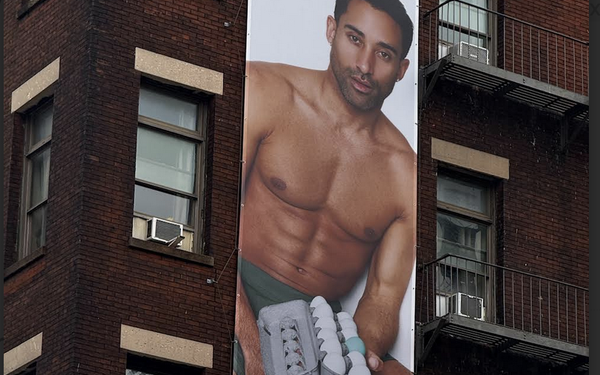
Rather, the “fertilized, not scrambled” kind, as touted on an attention-grabbing billboard which went up mid-February in New York City’s Soho neighborhood.

A 42-foot-tall photo of Stefen D’Angelica, best known for his stint on Discovery Channel’s “Naked and Afraid of Love” dating show spinoff, graces the billboard. D’Angelica, clad only in boxer shorts, holds an egg carton over his crotch. Under that, the board reads, “Fertilized, not scrambled.  @getlushi.”

Don’t even know where to start here, Doc. Maybe with the egg carton/crotch thing?

– Egged On

Dear EO,

Yes well let’s start at the beginning.

Lushi, for those of you keeping score at home, is a “fertility concierge platform” for egg freezing and IVF. About its name: “The Lushi is a rare breed of chicken known for laying blue eggs, with only a limited supply produced in its lifetime.”

That mirrors, according to Lushi’s website, “an important truth about women: they are born with all the eggs they will ever have, a finite resource that is both precious and powerful.”

Okay then.

Luchter’s piece also notes this: “D’Angelica is ‘pretty well known in the city as a very eligible bachelor,’ [Lushi founder-CEO Jessica] Schaefer points out, and the billboard has resulted in significant boosts to both Lushi’s website and social media, with ‘very high’ engagement.”

Checking in with the 42-Foot Himbo, a Google search for Stefen D’Angelica Lushi yields two links – one the MediaPost piece, the other an Ads of the World review.

Moving on to your local fertility concierge (available in New York, Los Angeles, Chicago, Boston and Austin), here’s the @getlushi Xitter feed.

(To be fair graf goes here)

To be fair, Lushi’s Tik-Tok feed has five followers.

The Doc’s diagnosis: Seems Lushi’s marketing could use a bit more fruitfulness of its own.

Why Is a Veteran Pharma Ad Copywriter Campaigning Against Pharma Ads?

Well the Doc opened up the old mailbag today and here’s what poured out.

Dear Dr. Ads,

There I was, minding my own business and checking out MediaPost’s Pharma & Health Insider, when I came across Les Luchter’s piece about the latest alarms over the “harmful outcomes” that prescription drug advertising has on consumers.

Since 2014, nonprofit RxBalance has been battling what it calls the “undue influence” of pharma marketing by running its own campaigns with such partners as Georgetown University for “Are You Prescribing Under the Influence? “[of pharma], targeted largely at healthcare providers.

Now, RxBalance has begun focusing more on telling the general public how pharma marketing can be less than transparent.  It recently launched an effort against costly Medicare drugs, focusing in particular on evidence that Eliquis from Bristol Myers Squibb/Pfizer’s Eliquis is no more effective than generic Warfarin in preventing strokes caused by atrial fibrillation — despite ad boastsof being “a better treatment.”

I dunno, Doc – is this just another do-gooder whistling past the – ahem – graveyard? Maybe RxBalance should team up with Robert F. Kennedy Jr., assuming Bobby Brainworm actually gets to run the Department of Health and Human Services.

– Drug Story

Dear DS,

For starters, the Doc already dealt with RFK 2.0 and his pipe dream of banning pharmaceutical advertising on TV.  So that’s a dead letter. (Maybe he can lay it out in Central Park in the dead of night, yeah?)

It’s hard to imagine that a bunch of civilians will have any better luck, but RxBalance founder Lydia Green told P&H Insider that she sees signs the landscape might be shifting for Big Pharma.

A lot of what we’ve been doing over the last 10 years is trying to convince people of things they find hard to believe [such as] that a doctor would make a decision…based on something that a sales rep told them. Now it’s much easier. So many of the concepts embedded in care right now were not established 10 years ago. And the pandemic created a sense of distrust in authority. People are much more open to our message.

People, sure. Federal regulators? Maybe not so much.

Even so, Green dreams on: “I personally would be happy to see no pharma advertising, and no brand awareness advertising.” Ditto for the folks at Jacobin, “a leading voice of the American left, offering socialist perspectives on politics, economics, and culture.”

In a piece headlined Drug Ads Misinform Patients and Raise Health Care Costs, Helen Santoro reported that according to one study, “drugmakers spent almost $16 billion over [a] six-year period to advertise products that didn’t provide at least moderate health benefits compared with existing therapeutic options.”

What the ads did provide, however, was a fantastic bang for the buck, as Santoro notes. “[A] report by Intron found that the return on investment from direct-to-consumer drug ads is incredibly high, ranging from 100 to 500 percent.”

So there’s that . . .

The Doc’s prescription: Keep hitting on that hopium, all you reformers. But don’t operate any heavy machinery while doing it.