How Much Is FanDuel’s Super Bowl LIX Ad Like Crack Cocaine for Gamblers?

Well they Doc opened up the old mailbag today and here’s what poured out.

Dear Dr. Ads,

There I was, minding my own business and checking out MediaPost’s Marketing Daily, when I came across Danielle Oster’s piece about the new teaser ad for FanDuel’s upcoming Super Bowl commercial/canoodle with the Fox broadcast network.

Former New York Giants quarterback Eli Manning stares at a screen with the word “Destiny” under an image of a football goal post over a cosmic background in the latest teaser for FanDuel’s upcoming “Kick of Destiny 3.”

“They say destiny finds you — unless your dad and brother want you to have a quarterback destiny instead,”  Manning intones in the ad’s voiceover. Eli’s philosophical waxing about destiny is interrupted when his brother Peyton — like Eli, a two-time Super Bowl champion — shows up to ask him what he’s doing, followed by a contentious exchange.

The new teaser’s playful brotherly rivalry tone is meant to stoke excitement for FanDuel’s “Kick Of Destiny 3” Super Bowl ad, and associated programming.

Wait – and associated programming? Yes, indeed.

The Mannings will have a kickathon during the Super Bowl pre-game show, but first “FanDuel [will call] on fans to place a free bet on which brother will win the competition, with winning picks earning an equal share of $10 million in ‘Bonus Bets’ on the platform.” Then FanDuel’s two spots during the game will recap the competition.

Look, Doc, I know the corn is off the cob, and the days of Super Bowl ads that were standalones  – paid (through the nose) commercials that ran during the game and that was that – are long gone. But isn’t this a bit much?

– Bet Noir

Dear BN,

The Doc has already passed judgment on the Axis of Wheedle – the unholy trinity of sports leagues, sports broadcasts, and sports betting. Spoiler alert: It will inevitably become corrosive if not corrupt, despite being pitched as good clean fun.

Exhibit Umpteen: Fanduel’s new teaser for its Super Bowl Adstravaganza.

The Manning brothers have replaced former New England Patriots loose end Rob Gronkowski, who blew his Chip Shots o’ Destiny the last two years. But what remains is the $10 Million in Bonus Bets that who knows how many suckers will divvy up, given that they have a 50-50 chance of picking the winning Manning brother.

Great odds, yeah?

Except so-called bonus bets can quite often be the gambling equivalent of handing out free dime bags of crack on the local street corner. As Jason Quick reported in this New York Times piece, “in 2023, the [sports gambling] industry brought in a record $10.92 billion, up 44.5 percent from 2022, according to the American Gaming Association.”

Beyond that, the rate of gambling problems among sports bettors is at least twice as high as it is for other gamblers, according to the National Council on Problem Gambling, which adds that “2.5 million U.S. adults (1%) are estimated to meet the criteria for a severe gambling problem in a given year. Another 5-8 million (2-3%) would be considered to have mild or moderate gambling problems.”

To top it all off, “youth gamblers [read: males 18-30] have higher rates of gambling problems than adults.” A Fairleigh Dickinson University poll found that “one-quarter of men under 30 bet on sports online; 10 percent of young men are problem gamblers.”

Of course, sports betting companies like Fanduel always give a nod to problem gambling in their promotional materials. Here’s what appears (not actual size) at the bottom of the Manning vs. Manning teaser for all of the last eight seconds.

The Doc’s diagnosis: We’re laying plenty of eight-to-five that this problem just gets worse the more “bonus bets” get circulated. You can take that to the bank. Or not, odds are.

Why Is a Veteran Pharma Ad Copywriter Campaigning Against Pharma Ads?

Well the Doc opened up the old mailbag today and here’s what poured out.
Dear Dr. Ads,

There I was, minding my own business and checking out MediaPost’s Pharma & Health Insider, when I came across Les Luchter’s piece about the latest alarms over the “harmful outcomes” that prescription drug advertising has on consumers.

Since 2014, nonprofit RxBalance has been battling what it calls the “undue influence” of pharma marketing by running its own campaigns with such partners as Georgetown University for “Are You Prescribing Under the Influence? “[of pharma], targeted largely at healthcare providers.

Now, RxBalance has begun focusing more on telling the general public how pharma marketing can be less than transparent.  It recently launched an effort against costly Medicare drugs, focusing in particular on evidence that Eliquis from Bristol Myers Squibb/Pfizer’s Eliquis is no more effective than generic Warfarin in preventing strokes caused by atrial fibrillation — despite ad boastsof being “a better treatment.”

I dunno, Doc – is this just another do-gooder whistling past the – ahem – graveyard? Maybe RxBalance should team up with Robert F. Kennedy Jr., assuming Bobby Brainworm actually gets to run the Department of Health and Human Services.

– Drug Story

Dear DS,

For starters, the Doc already dealt with RFK 2.0 and his pipe dream of banning pharmaceutical advertising on TV.  So that’s a dead letter. (Maybe he can lay it out in Central Park in the dead of night, yeah?)

It’s hard to imagine that a bunch of civilians will have any better luck, but RxBalance founder Lydia Green told P&H Insider that she sees signs the landscape might be shifting for Big Pharma.

A lot of what we’ve been doing over the last 10 years is trying to convince people of things they find hard to believe [such as] that a doctor would make a decision…based on something that a sales rep told them. Now it’s much easier. So many of the concepts embedded in care right now were not established 10 years ago. And the pandemic created a sense of distrust in authority. People are much more open to our message.

People, sure. Federal regulators? Maybe not so much.

Even so, Green dreams on: “I personally would be happy to see no pharma advertising, and no brand awareness advertising.” Ditto for the folks at Jacobin, “a leading voice of the American left, offering socialist perspectives on politics, economics, and culture.”

In a piece headlined Drug Ads Misinform Patients and Raise Health Care Costs, Helen Santoro reported that according to one study, “drugmakers spent almost $16 billion over [a] six-year period to advertise products that didn’t provide at least moderate health benefits compared with existing therapeutic options.”

What the ads did provide, however, was a fantastic bang for the buck, as Santoro notes. “[A] report by Intron found that the return on investment from direct-to-consumer drug ads is incredibly high, ranging from 100 to 500 percent.”

So there’s that . . .

The Doc’s prescription: Keep hitting on that hopium, all you reformers. But don’t operate any heavy machinery while doing it.

Why Is a Swedish VPN Service Ripping Off A Classic Volkswagen Print Ad?

Well the Doc opened up the old mailbag today and here’s what poured out.

Dear Dr. Ads,

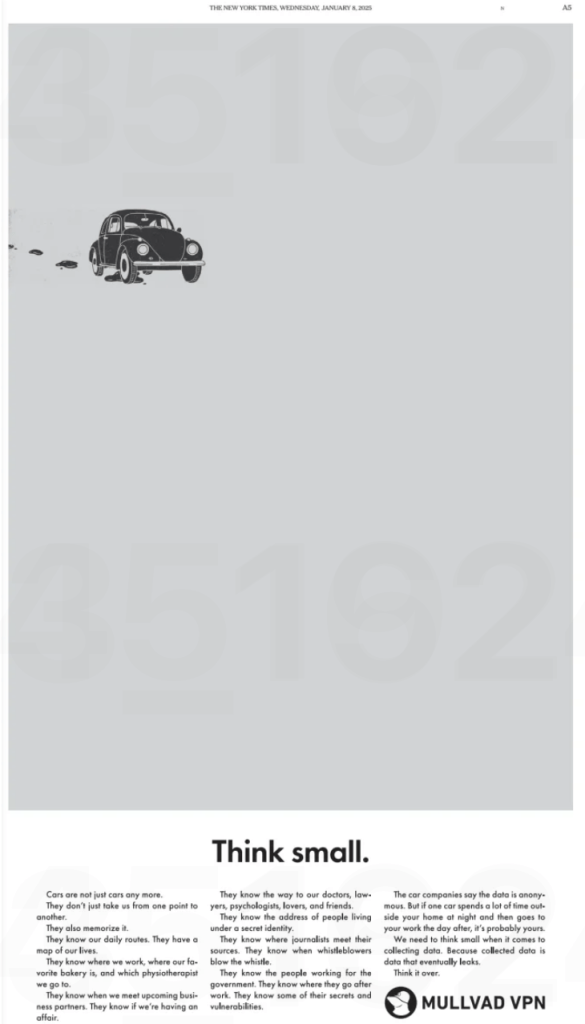
There I was, minding my own business and leafing through the New York Times, when I came across this full-page ad on A5.

That’s hardly kosher, is it Doc – outright pirating Volkswagen’s revolutionary 1959 ad? Does there remain no honor among hucksters? (Rhetorical question, of course.)

– Really Bugged

Dear RB,

The legendary ad agency Doyle Dane Bernbach really did something miraculous in the 1960s: Barely two decades after the end of World War II, it turned Adolf Hitler’s “people’s car” into an American icon.

Twice. (VW Bug, VW Bus.)

Here’s the other DDB classic ad from its launch campaign.

That car, the ad tells us, was pulled from the line because the chrome strip on the glove compartment was – gasp – blemished.

Drive U.S. automakers nuts graf:

This preoccupation with detail means the VW lasts longer and requires less maintenance, by and large, than other cars. It also means a used VW depreciates less than any other car.

The kicker: “We pluck the lemons; you get the plums.”

But back to Mullvad VPN. Here’s the company’s pitch, which is a bit of a roundhouse curve.

That “leaks” reference accounts for the black blotches beneath the Beetle in the ad. But we’re still left with this question: Why would an essentially unknown internet provider pay six figures to knock off an ad that only a fraction of its target market might recognize?

Two reasons come to mind: 1) Digital media has made popular culture – like time – a flat circle, so large swaths of people know one of The Greatest Print Campaigns of All Time, and 2) Like Volkswagen in the ’60s, Mullvad VPN is a Euro-upstart battling the behemoths – and seeming to get pretty good reviews so far, especially in the area of privacy.

The Doc’s diagnosis: At a time when your car will soon be driving you and Mark Zuckerberg is driving Meta into a ditch and Elon Musk is driving everyone else crazy, maybe a private Swedish massage would feel pretty good right about now.

Your mileage may vary.